Transposing Worship Songs and Using Capos
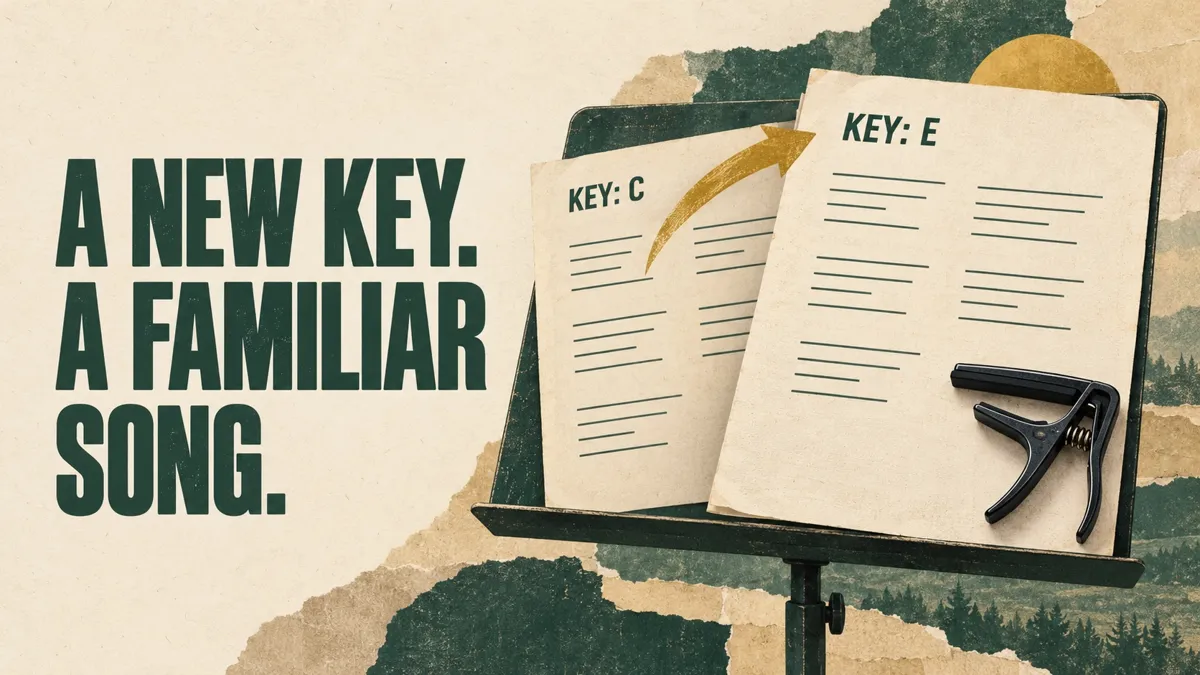
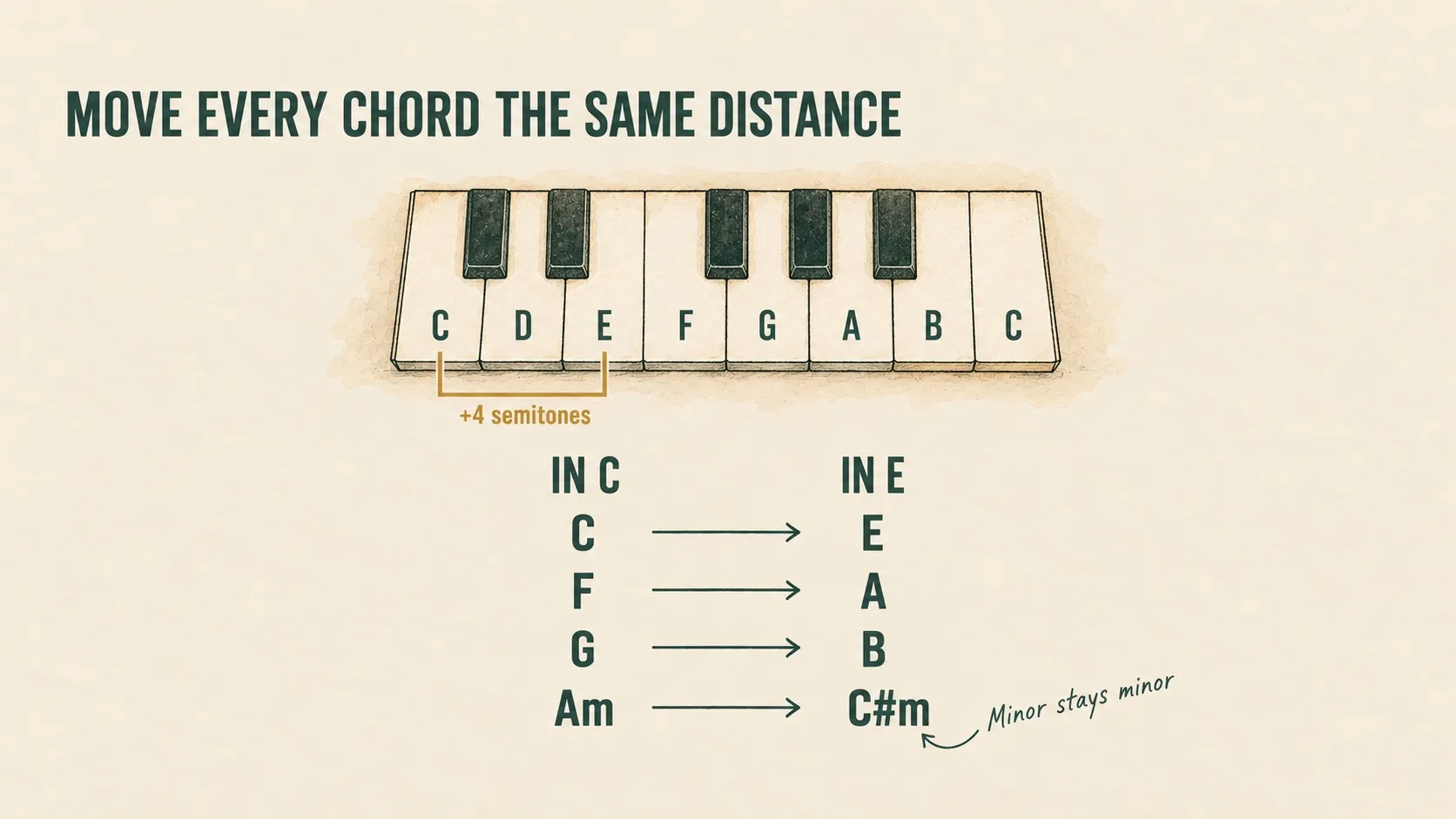
To transpose a song, move every chord's root note up or down by the same number of semitones and keep the chord types as they are. Going from C to E is four semitones up, so C becomes E, F becomes A, G becomes B and Am becomes C♯m. Then play the new chart through once before anyone else sees it. A capo lets a guitarist keep familiar chord shapes in the new key. It's a real help for acoustic players who rely on open chords, and much less needed on electric guitar, where you can slide the same shapes up and down the neck.
Changing keys is normal. Songs get moved to fit the singer, the occasion or the room, whether that's a small group, a worship night or an ordinary Sunday morning. This post covers how to actually do it: by hand, on the fretboard, with a capo, and without anyone ending up with the wrong chart.
It's written for volunteer worship leaders and musicians at small churches. Which key to choose in the first place is covered in our guide to what key a worship song should be in.
How Do You Transpose a Song by Hand?
Count the distance between the old key and the new one in semitones, then move every chord by exactly that distance. Transposition always means moving everything by the same interval. That's why the song still sounds like itself, just higher or lower.
These are the twelve notes in order, one semitone apart:
| 1 | 2 | 3 | 4 | 5 | 6 | 7 | 8 | 9 | 10 | 11 | 12 |
|---|---|---|---|---|---|---|---|---|---|---|---|
| C | C♯/D♭ | D | D♯/E♭ | E | F | F♯/G♭ | G | G♯/A♭ | A | A♯/B♭ | B |
After B the row starts again at C. Then, step by step:
- Count the semitones from the old key to the new key. From C to E is four steps up: C♯, D, D♯, E. It's easiest to count on a piano keyboard or along one guitar string, one fret at a time.
- Move the root of every chord by that number. The root is the note the chord is named after, including any sharp or flat. In B♭m the root is B♭, and the m tells you the chord is minor.
- Keep the chord type. Am stays minor, G7 keeps its 7, and Dsus4 keeps its sus4. B♭m moved up two semitones becomes Cm.
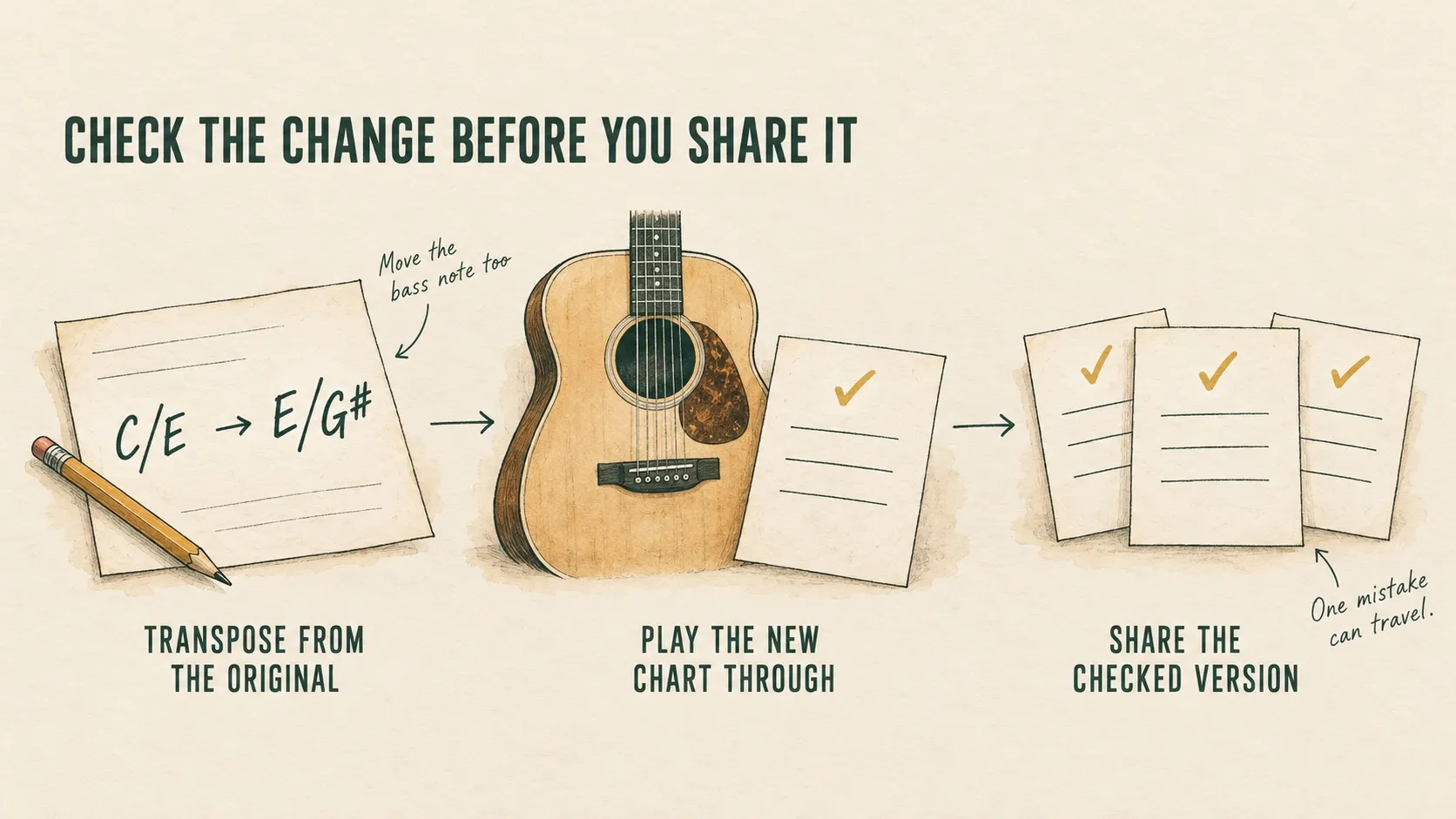
- Move the bass note in slash chords too. C/E moves up four as well and becomes E/G♯.
- Spell the chords the way the new key does. In E, write C♯m rather than D♭m. In B♭, write E♭ rather than D♯. Sharp keys like G, D, A, E and B use sharps; flat keys like F, B♭, E♭ and A♭ use flats.
A Worked Example: Moving a Song From C to E
Suppose a song in C uses C, F, G, Am and C/E, and the singer wants it higher. Move everything up four semitones:
| In C | In E |
|---|---|
| C | E |
| F | A |
| G | B |
| Am | C♯m |
| C/E | E/G♯ |
Go through every chord on the chart the same way, including the intro, the bridge and any odd passing chord you only play once. Passing chords are where hand-transposed charts usually go wrong.
Moving down works the same way. To take a song from D down to C, lower every chord by two semitones: D, G, A and Bm become C, F, G and Am.
Using the Circle of Fifths
The circle of fifths is a shortcut once you know your way round it. It places the keys in a ring where each key sits next to the keys it shares the most chords with. A key's main chords are neighbours on the circle: in C, those are F, C and G, with their relative minors Dm, Am and Em on the inner ring. Turn the circle to E and the same pattern gives you A, E and B, with F♯m, C♯m and G♯m.
So if you know a song is built on the 1, 4 and 5 chords of its key, plus the 6 minor, you don't have to count every chord. You find the new key on the circle and read the chords from the same positions around it.
On the Fretboard
On guitar and bass, one fret is one semitone. Barre chords, power chords and bass lines don't change shape when the key changes. They just move: up four semitones means four frets up the neck. Most of the time that's how a guitarist or bassist transposes in the moment, without writing anything down.
When Should a Worship Guitarist Use a Capo?
Use a capo when you want to play familiar open chord shapes in a key where they don't naturally sit. A capo works like a movable nut: every fret you place it up raises the pitch by a half step, or one semitone, so the same shapes sound in a higher key.
It's most useful for:
- Acoustic guitarists who rely on open chords
- Beginners who know a handful of shapes and need to play in another key
- Two guitarists, where one plays open shapes and the other plays the same chords higher up with a capo, so the two parts don't sit on top of each other
It's less useful on electric guitar. In our team we rarely use one. Electric parts tend not to use many open chords, and fitting a capo mid-set breaks the flow, partly because you need to check your tuning afterwards. At home, playing alone, it's easier to fiddle with.
That's mostly a matter of practice. If you're well rehearsed, putting a capo on between songs isn't a problem. Just keep a tuner at hand and check your tuning after fitting the capo. A capo can pull strings slightly sharp, especially if it clamps harder than it needs to, and not always every string by the same amount. We covered how to tune with a capo on in the tuning guide, and there's a free tuner in your browser if you don't have one.
What Chords Do You Play With a Capo?
The shapes you play plus the capo fret give you the key you hear. G shapes with the capo on fret 3 sound in B♭, because B♭ is three semitones above G. To find the capo fret for a new key, count the semitones from a key whose shapes you know up to the key you need.
| Key you need | Capo and shapes |
|---|---|
| A♭ | Capo 1, G shapes · Capo 4, E shapes |
| B♭ | Capo 1, A shapes · Capo 3, G shapes |
| B | Capo 2, A shapes · Capo 4, G shapes |
| D♭ | Capo 1, C shapes · Capo 4, A shapes |
| E♭ | Capo 1, D shapes · Capo 3, C shapes |
| F | Capo 1, E shapes · Capo 3, D shapes |
| F♯ | Capo 2, E shapes · Capo 4, D shapes |
Lower capo positions keep the sound fuller. Higher ones sound brighter and thinner, which can be exactly what a second guitar part needs.
A Worked Example: A Beginner in B♭
Imagine a beginner guitarist who knows G, C, D and Em and not much else, and the song is in B♭. With the capo on fret 3, they play those same four shapes and the band hears B♭, E♭, F and Gm. They don't need to learn a single new chord to play the song.
The capo doesn't replace preparation, though. Practise the whole song with the capo in place, including getting it on in time for the song and the transitions in and out, so you can play it confidently with the team.
Why Do Hand-Transposed Charts Go Wrong?
Mostly because a mistake gets copied. Before we used an app, transposing a song meant going through each chord on the paper by hand, and then doing the same for every teammate who couldn't do it themselves. Copying the next sheet from the first one was the quickest way. It also meant one wrong chord on the first sheet turned up on all of them.
If we were lucky, it came out at rehearsal: this part sounds strange… oh, that's the wrong chord, it should be this one. A wrong chord on your own sheet you'll usually hear. On a teammate's sheet you might not, and they'll simply play it. A beginner may not notice either.
The lesson: transpose once, from the original, and play it through before anyone else gets a copy. When we did it at home before a rehearsal, we played the new chart through several times before starting the printer, because scratching out and correcting chords afterwards was a pain. When it had to happen at the last minute, the chart was whatever it was. That says more about the preparation than the chart. As young, creative leaders we were often well prepared but not organized.
Really, you shouldn't have to copy charts at all, or transpose them by hand, or print them. And printers always break at the worst moment.
Who Finds a Key Change Hardest?
Usually the beginners. Players who only know chords in a few keys often prefer to stay in them, and a song moved from G to B♭ takes away every familiar shape at once. Everyone else adapts more easily than you'd expect:
- Drums barely notice the key.
- Electric guitar and bass can usually move the same shapes up or down the neck.
- Acoustic guitar loses its open chords in some keys. That's where a capo helps.
- Keys players find some keys more comfortable than others. A move can take a simple white-key part onto the black keys.
- Brass and woodwind have it harder, because they read written parts rather than chord charts, so a new key needs a new part. Many of them play transposing instruments: a B♭ trumpet or clarinet sounds a tone lower than written, so its part isn't written in the band's key in the first place. Not many small churches have a horn section these days, but if yours does, give those players the new key early.
The bigger risk isn't the chart. It's the player who practised all week in the old key and isn't yet at a level where they can switch on the spot.
When Should the Key Be Decided?
Send out a starting key before people start practising at home. Most of the time a song is already in the team's key, because the leader has prepared it and knows it fits, so the starting key is simply the one on the chart.
Sometimes rehearsal shows that it doesn't work. Someone else might be singing that day, or the occasion needs something different. Then agree the change together at rehearsal, and give everyone time to practise it before the service.
The key rarely needs to change on Sunday morning. And it's worth remembering that a small church service isn't a concert. Bigger churches and bigger events tend to lock every detail well in advance, which is natural: people prepare more for the services that feel important. For an ordinary Sunday at a small church, a starting key sent out in advance and a check together at rehearsal is usually enough.
Trying Keys at Rehearsal in Minutes
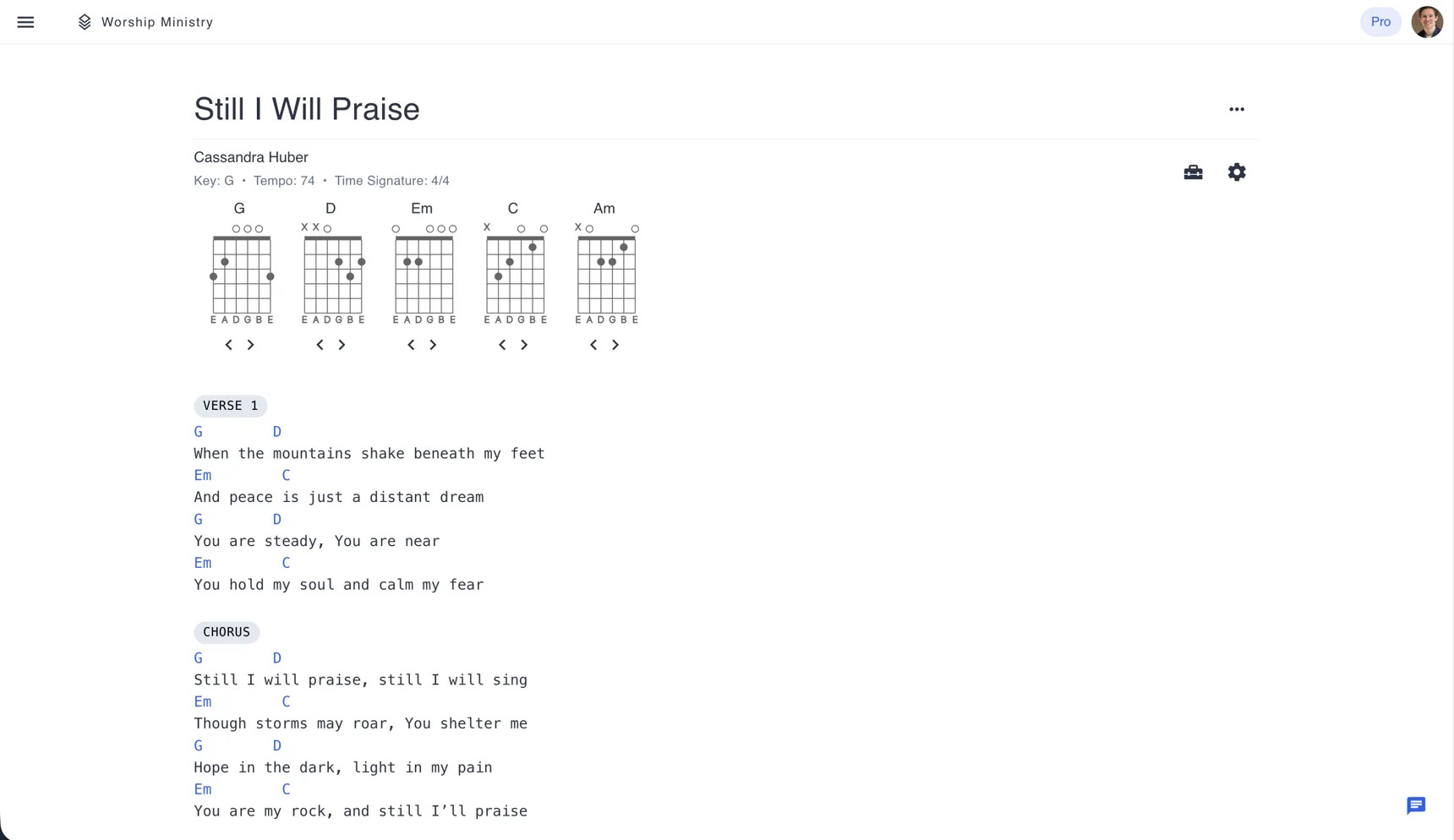
The easiest key change is one nobody has to write down. In Song7, the leader sets the key on the song in the set, and every musician's chart changes on their own device straight away. At our last rehearsal we moved a song to fit the singer better. The leader changed the key, everyone's chart updated, and we kept playing. No rewrites, no reprinting, nobody playing from last week's sheet.
That makes it easy to experiment. Try the chorus in two or three keys with the singer, hear which one sits right, and keep that one. It takes a couple of minutes.
Each player can also view the song in their own key or with a capo without changing anyone else's chart. Set capo 3 and the chart shows the shapes you actually play. Our own team doesn't use it much, but a player we know uses it at another church where they play, and at home when they sing together.
Key Takeaways
| Point | Details |
|---|---|
| Move every chord the same distance | Count the semitones between the keys and move each chord's root, including slash bass notes. |
| Move the root, keep the chord type | B♭m up two semitones becomes Cm; spell the new chords the way the new key does. |
| Capo shapes plus fret give the key | G shapes with capo 3 sound in B♭; check your tuning after fitting the capo. |
| Transpose once, from the original | Copying from a copy spreads a single wrong chord to every chart. |
| Play it through before sharing | A wrong chord you'll hear on your own chart may go unnoticed on a beginner's. |
| Send a starting key before practice | If rehearsal shows a problem, agree the change together and give everyone time to adjust. |
Frequently Asked Questions
Changing the Key Is Normal
Moving a song to fit the singer, the room or the occasion isn't a failure of the original arrangement. It's part of leading worship. The work is in getting the change to the whole team cleanly: move every chord the same distance, check it by playing it, and make sure everyone is reading the same chart.
At your next rehearsal, pick one song that hasn't been sitting right for the singer and try it a step up and a step down. Keep whichever one the room can sing.
Related reading: What key should a worship song be in?