How Should a Worship Team Tune Before a Service?
A worship team should normally use A440 as its shared tuning reference, tune after setup, and check again just before the service with capos on. Confirm that tuners, keyboards, and any playback agree; an acoustic piano may need special attention. Getting the pitch right is the easy part. Keeping it through a Sunday morning is where most bands slip.
This is written for volunteer bands at small churches: a guitar or two, a bass, keys, and nobody whose job it is to look after the sound.
The Short Answer
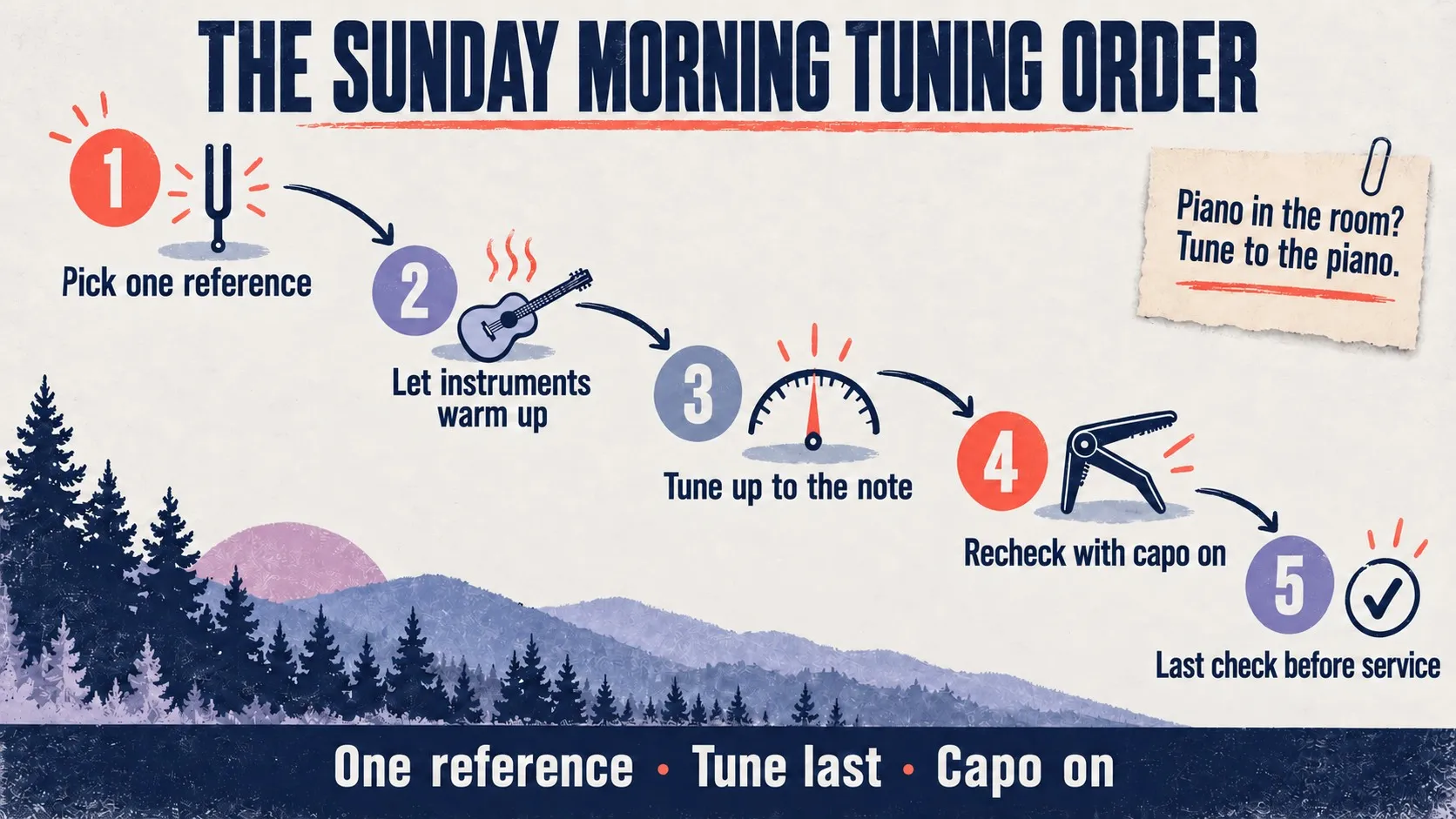
- Confirm A440 on the team's tuners. It's a common default, but an adjustable tuner may have been changed.
- Let the instruments settle first. A guitar that came in from a cold car will keep drifting as it warms up. Tune the final time after it has been out of the case for a while.
- Tune up to the note. If a string is sharp, drop it below the note and come back up.
- Check again with the capo on. Capos pull strings slightly sharp, and not all strings by the same amount.
- Do a last quick check a few minutes before the service — after soundcheck, when the room and the lights are at their Sunday temperature.
- Tune silently during the service with a clip-on or pedal tuner, never through the PA.
For a final listening check, compare the same sustained note across instruments, with chorus or other pitch effects off. Obvious beating is a reason to recheck. Don't expect a full chord to sound perfectly still; chord voicings, temperament, and effects can complicate what you're hearing.
What Pitch Should a Worship Band Tune To?
Use A440 as the normal reference: the A above middle C vibrating 440 times a second. Check the tuners and keyboard rather than assuming their settings agree. For example, the BOSS TU-3 manual allows its reference to be adjusted from 436 to 445 Hz. If one player's tuner was changed, each instrument can read as in tune on its own and still clash with the others. Check any backing tracks or pads against the same reference too.
The one exception: an acoustic piano
If your church still leads from an acoustic piano, check it before you assume it's at 440. Acoustic pianos drift: the Piano Technicians Guild explains that dry air flattens the wooden soundboard, which lowers string tension and drops the pitch, and recommends tuning at least twice a year. A piano that hasn't been serviced in a while can sit a few cents flat.
You usually can't arrange a piano tuning just before the service. If the piano is reasonably in tune with itself but sitting at a different overall pitch, the band can follow it. Play the A above middle C and read it on a chromatic tuner set to A440:
- It reads A, −8 cents → the piano is at about 438 Hz. Set everyone's tuner reference (sometimes called calibration or A4) to 438, and set the same number in the master tune menu on any digital keyboard.
- It reads within a couple of cents of A → close enough. Stay at 440.
Then try a few notes and chords together. Matching one A doesn't fix a piano whose notes have drifted unevenly. If it still clashes, use another keyboard for the service and arrange a piano tuning.
If you play to backing tracks, check their actual pitch before changing the band's reference. Some playback setups allow fine pitch adjustment, but that needs preparing and rehearsing. If the tracks are at 440 and you can't adjust them reliably, stay at 440 and leave the drifting piano out of those songs.
When Should the Team Tune on a Sunday Morning?
Tune twice: once after setting up, and once more a few minutes before the service. The first tune gets everyone close; the second catches whatever the room has done to the instruments since.
Rehearsal setup is usually 10-20 minutes of cables, stands and catching up — we walked through where the time in a volunteer rehearsal actually goes in an earlier post. Tuning belongs at the end of that setup, not the start. By then the guitars have been out of their cases for a while and are closer to room temperature.
Then the room changes. The heating that came on an hour before the service catches up. The stage lights go on. The first run-through warms the strings under everyone's hands. Each of those moves the pitch a little, which is why the last check belongs a few minutes before the doors open, not at 8 a.m.
Why Does My Guitar Keep Going Out of Tune on Sunday?
Three things cause most Sunday-morning drift: temperature, new strings and capos.
- Temperature. A move from a cold car to a warm room can disturb tuning as the instrument settles. Check the direction of the drift on your tuner rather than assuming every string will go flat. Let the guitar acclimatize, and make the final check after setup.
- New strings. Fresh strings keep stretching for the first day or two of playing and keep going flat. Change strings earlier in the week and play them in, not on Saturday night.
- Capos. A capo presses the strings harder than your fingers do, which pulls them slightly sharp — and because every string has a different gauge and tension, they don't all move by the same amount. Put the capo on just behind the fret, then check the tuning with it on. Small corrections only; if a string is badly off, take the capo off, tune, and put it back.
If open strings read in tune but fretted chords still sound wrong, the problem may be intonation. Taylor's explanation of guitar intonation describes how a setup can help; repeatedly retuning the open strings won't resolve every problem along the neck.
Why "Tune Up to the Note"?
Approaching the note from below helps take up slack in the tuning mechanism. Taylor's tuning guide recommends loosening a sharp string below the target, then tuning up to it. It's a useful habit, though it won't fix a string that binds at the nut or a guitar that needs a setup.
So if a string reads sharp, bring it clearly below the note, then bring it back up and stop on it.
How Do You Tune Quietly During the Service?
Use a tuner that feels the instrument rather than hears the room, and mute your signal while you tune.
A clip-on tuner reads vibration through the headstock and is generally more useful than a microphone tuner on a busy stage. If its reading jumps around, find a quieter moment or use a direct-input tuner. Many pedal tuners mute an electric or amplified acoustic while engaged; confirm that yours does, and remember that a clip-on doesn't mute the instrument for you. Microphone-based tuners — including phone apps and browser tuners — can pick up the band or a pad instead of your guitar. Use them in a quiet room before the service or rehearsal.
If a guitar goes out mid-set, tune between songs while the keys hold a pad. A guitarist quietly tuning under a pad is invisible. A guitarist strumming open strings through the PA is not.
What About Bass, Ukulele and Alternate Tunings?
Use the same reference pitch for bass, ukulele, violin, and the other pitched instruments. A440 is a reference, not the note every string should play. Each instrument keeps its own tuning; a bass's low E is still E, just measured against the same pitch standard.
If a song needs drop D or another alternate tuning, retune before the set rather than between songs — or bring a second guitar already tuned for it. Retuning mid-set takes longer than anyone expects, and the string you just dropped will keep drifting for a song or two.
A Free Tuner for Before the Service
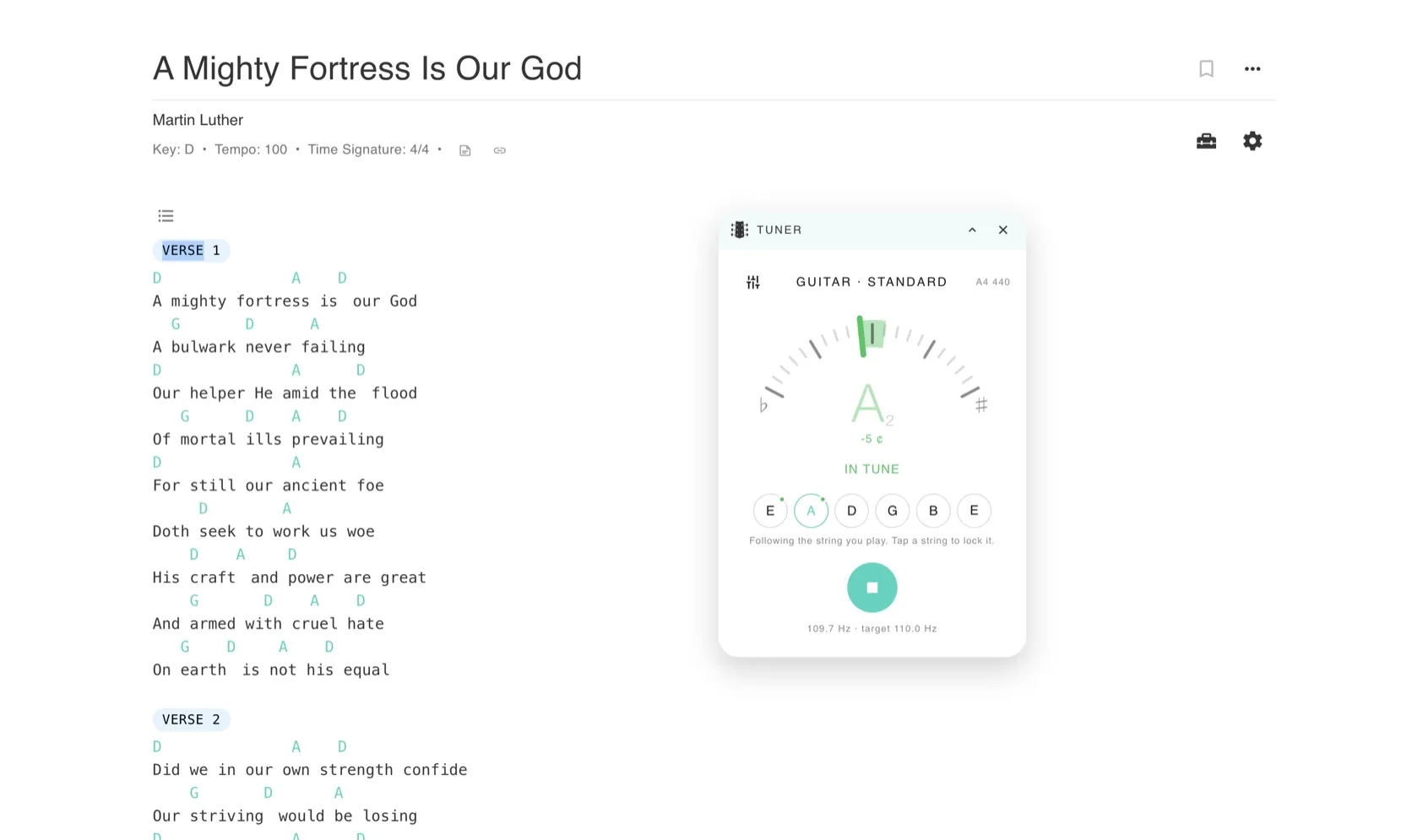
The free online tuner on Song7 runs in the browser with nothing to install, and the audio never leaves your device. It handles guitar (standard, drop D, half step down, DADGAD), bass, ukulele and chromatic mode, follows whichever string you play, and marks each string once it's in tune. The reference pitch is adjustable for the odd acoustic piano. Inside Song7 the same tuner sits one tap away from your chord charts, next to the metronome. Try Song7 free.
Key Takeaways
| Point | Details |
|---|---|
| Set the band's reference to A440 | Check tuners and keyboards agree before anyone starts tuning. |
| Tune again just before the service | The check after setup won't catch everything that drifts before the first song. |
| Check with the capo on | Fit the capo for the next song, then correct any strings it pulls sharp. |
| Mute before you tune | A clip-on reads vibration but doesn't silence your signal through the PA. |
| Match more than the piano's A | If you follow an acoustic piano's pitch, check several notes and chords before settling on it. |
Frequently Asked Questions
Make the Final Check Part of the Service Routine
At the next soundcheck, agree who will give the team a quiet reminder to tune a few minutes before the service. Leave enough time to fit the first song's capo and check one shared note. A final check is easy to forget when everyone assumes someone else has remembered it.
Related reading: How to lead worship without a full band