How Should a Worship Team Rehearsal Be Structured?
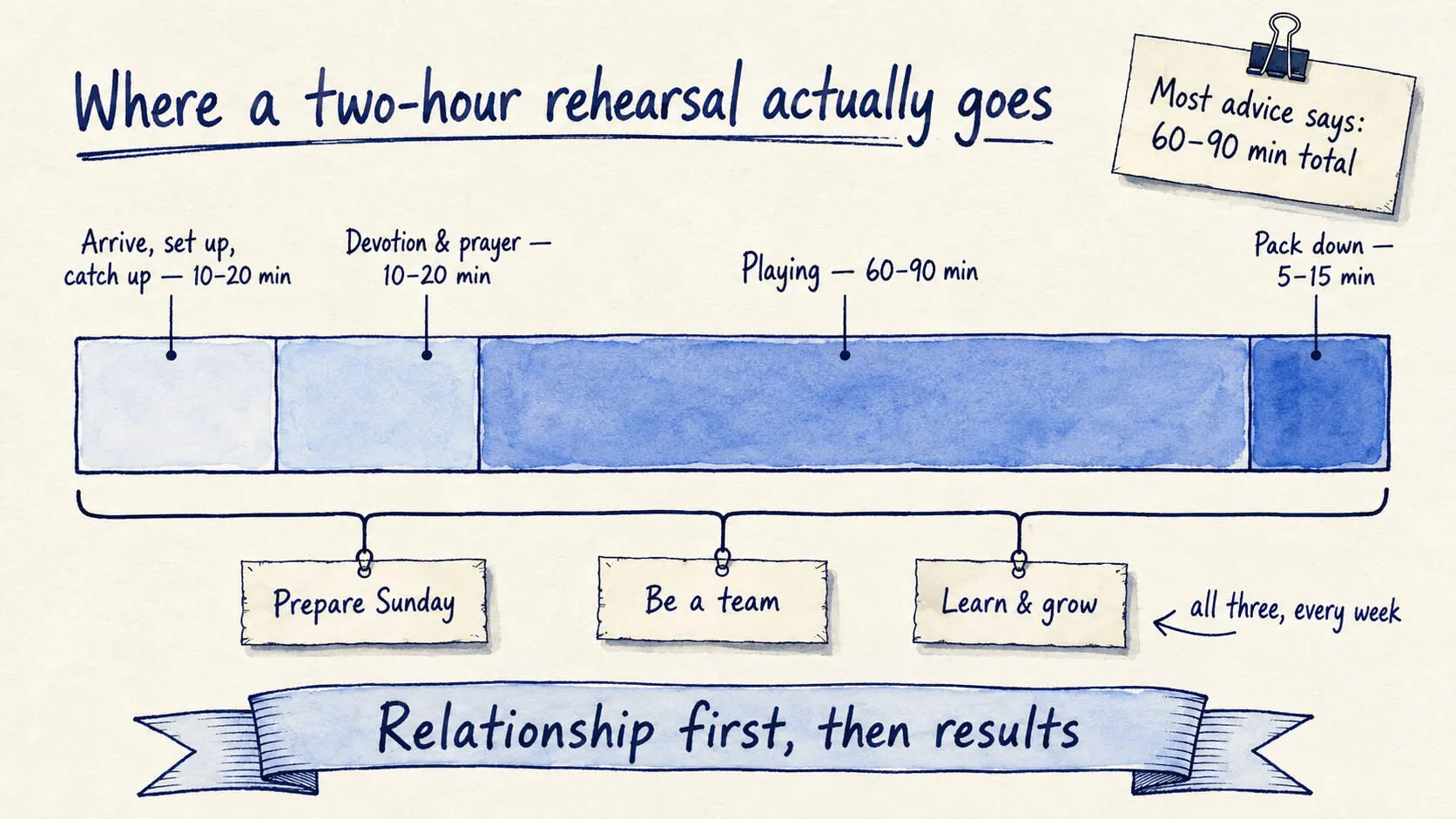
A typical volunteer worship rehearsal runs about two hours: 10-20 minutes setting up and catching up, 10-20 minutes of devotion and prayer, the rest playing, and 5-15 minutes packing down. Most published advice will tell you to tighten that to 60-90 minutes and cap the devotional at five. Whether that advice is right for you depends on something the advice rarely asks: what else is your rehearsal doing besides preparing music?
This is written for worship leaders and musicians at small churches, where everyone is a volunteer and the evening is being given up rather than paid for.
Where the Two Hours Actually Go
Here is the honest shape of a mid-week rehearsal for a team of six or seven — a drummer, one or two guitars, one or two on keys, a couple of singers, and a leader who usually plays something too.
| Phase | Time | What's really happening |
|---|---|---|
| Arriving, gear, catching up | 10-20 min | Cables, tuning, "how was your week" — this is not wasted time |
| Devotion, talk, prayer | 10-20 min | The team becomes a team rather than a lineup |
| Playing | 60-90 min | The set, the transitions, and usually one new song |
| Packing down | 5-15 min | Plus whoever stays behind talking, on their own time |
Compare that to the standard recommendation. Worship Online suggests a 60-90 minute rehearsal, a cap of 10 minutes per song on a five-song set, verbal direction kept to "30 seconds or less" between songs, and a devotional of five minutes maximum.
Those numbers are good, and if your rehearsals sprawl they will help. But notice what they assume: that rehearsal is a music-preparation meeting and everything else is overhead to be trimmed. For a lot of small churches that assumption is simply wrong.
Rehearsal Is Doing Three Jobs at Once
A volunteer rehearsal is carrying three loads simultaneously, and most frustration with rehearsals comes from only counting the first one.
- Preparing Sunday. The set, the keys, the arrangements, the transitions.
- Being a team. For many teams this is the only time all week these people are in a room together. The catching up isn't a preamble to the rehearsal; for some of your people it's a reason they came.
- Learning and growing. New songs, better playing, and for younger or newer musicians, learning how church music works at all.
Two hours is genuinely good for one of those jobs. It is rarely enough to move all three forward in any big way. That's not a failure of your discipline — it's arithmetic. Naming it helps, because it explains why the same rehearsal gets described by one person as a big commitment and by another as the bare minimum that should really be happening twice as often.
Both of them are right. They're measuring different jobs.
Why Almost Nobody Arrives Prepared
Very few people look at the setlist before they arrive. That is the normal state of a volunteer team, not a sign that yours is uniquely undisciplined.
Think about who is walking in. They have jobs and families. It's an evening in the middle of a busy week, taken away from their family and given to the church. Many arrive half-drained, and if the week ran over them, nobody prepared anything at all. The rehearsal is their preparation.
You can respond to that in one of two ways, and only one of them works.
The first is to try to fix people — send the setlist earlier, remind harder, express disappointment. Some of that is fair, and the standard advice is right that a setlist should go out ahead with keys, tempos and reference recordings included, not just song titles. Sending it three days out costs you nothing.
The second is to change what you ask people to prepare. That one is worth a section of its own.
Give the Band a Repertoire, Not Just a Setlist
The most useful thing you can hand a volunteer musician is not this week's setlist — it's the current repertoire. A defined group of songs the team is in right now, that they can practice at home whenever they have a spare twenty minutes, without needing to know what Sunday holds.
This quietly solves several problems at once:
- Preparation stops being weekly. Nobody has to catch a Thursday email to be ready. They work on the same 10-15 songs across a season.
- The setlist deadline relaxes. If the band knows the repertoire, it matters far less whether the set was finalized on Tuesday or gets adjusted in the room.
- It survives a bad week. Someone who had no time this week is still carrying last month's practice.
- It makes room for the Spirit without making a mess. A leader can change direction on Sunday morning and the band can follow, because the songs are already in their hands.
You still want the set out in advance where you can. But the repertoire is the thing that makes a team ready, and the setlist is only ever a selection from it.
This is the gap Song7's Collections were built for: a named, team-shared group of songs for the season's rotation, with each song carrying its key, tempo and chart, on every musician's device. Editors keep it current, the team practices from it, and building Sunday's set becomes picking from a list everyone already knows. See how Song7 keeps a team's repertoire in one place.
Related: our guides on organizing your church song library and choosing the right key for a song both feed directly into this.
Should the Setlist Be Settled Before Rehearsal or During It?
Settle it in advance where you can — but how strictly depends on the leader and the group, and there's more than one legitimate way.
The directive approach. The leader plans everything ahead and tells people what to play. It's straightforward, it's efficient, and people can show up and follow. There may be questions and suggestions, but the shape is set.
The consensus approach. The group decides together what goes on the list. This is slower and it uses rehearsal time, but it's often necessary — especially where several people lead, or where each of a few leaders takes a song.
The Spirit-led approach. Less "what's on the list" and more "what does it seem the Lord is doing right now, and what should we carry into Sunday?" Here rehearsal tilts away from getting songs right and toward getting hearts ready — which works precisely because the repertoire is already familiar.
Most teams are a blend, and the blend shifts with the season and the people in the room. What matters more than picking one is that everybody knows which one they're in. Half the friction in a rehearsal is one person expecting a plan while another expects a conversation.
Planning and Being Led Are Not Opposites
God can lead a worship leader on Tuesday just as easily as on Sunday morning — but don't forget to bring Him onto the stage too.
There's a real difference between receiving instructions and doing something together. It's tempting to want the first: ask God what to do, get the answer, go and execute it. Simple. Clean. But the invitation seems to be relational rather than instructional — not orders handed down, but a plan made together, and someone who comes with you while you carry it out.
In our eagerness to lead we can forget to be led, and in our planning we can forget the One with the plan.
The failure runs both ways, though, and the other ditch is just as real. "Spirit-led" can quietly become an excuse for not planning, not practicing, and asking a room of volunteers to cover for it. Proverbs 16:9 holds both halves together: we plan our course, and the Lord establishes our steps. Neither clause is optional.
If it comes to choosing, the order is: relationship first, results second. Build and nurture your relationship with God and with the people in the room, then chase the practical. Do the second without the first and it goes flat and hollow — technically fine, and somehow not worth being in the room for.
Which, incidentally, is why the "trim the devotional to five minutes" advice deserves a second look before you apply it. Jeff Deyo's rules for rehearsal start the night with a spiritual-growth activity and end it with the team circled up in prayer, and that's a very different theory of what the evening is for.
What Actually Eats the Time
If your rehearsals run long and cover less than you hoped, it's usually one of these — and the first two are the leader's, not the team's.
- Nobody planned what to rehearse. Turning up without a plan for the rehearsal itself costs more than any late arrival.
- A song nobody knows, dropped in cold. Deyo's fix is a good one: start with the least-known song, while everyone is fresh and there's still time to abandon it.
- People who haven't practiced their parts, which turns rehearsal into what Worship Online calls "a teaching session instead of a practice session."
- Late starts. Beginning at 7:10 when you said 7:00 takes the time straight out of whatever needed it most.
- Sound and gear. Messy cables, someone moved things on stage since last week, a string goes on the bass.
- Forgotten charts. Someone's left their folder or device at home and now they're sharing a music stand.
- Talking. Small talk that never ends, or long explanations between songs. Worship Online estimates this alone can cost 15-20 minutes a session.
- The mood in the room. One person arriving in a bad mood can turn a life-giving rehearsal into a drama session. Musicians run hangry and grumpy more often than anyone admits. Notice it early — a break, a snack, or a quiet word costs five minutes and saves the evening.
One more that's easy to miss: practicing songs in isolation and never running the set as a set. If you only ever work on individual songs, you never rehearse the thing your congregation will actually experience. Run it top to bottom, transitions included, then go back for the one or two spots that need it.
Rehearsal Is Where Your Team's Culture Gets Built
Sunday is where a team's culture shows. Wednesday is where it gets made.
Nobody builds a culture by announcing one. Culture is the sum of what gets repeated and what gets tolerated — and rehearsal is the only place in the week where your team does anything repeatedly, together, with enough time for it to sink in. Whatever happens in that room for two hours a week is what the team slowly becomes, whether you're paying attention to it or not.
Which is one more reason to be careful with the "trim the devotional, tighten the run-through" advice. A rehearsal that only ever prepares music will produce a team that only ever prepares music. That's a culture too — it's just not one anybody chose. What happens on that stage on Sunday is ministry, and so is what happens in the room on Wednesday. It isn't only practice.
Five Things That Hold a Culture Together
None of these take long. They work because they repeat.
- Go first. Culture is set by what you do, not by what you announce. If you want people to arrive on time, own their mistakes, or play less when the moment calls for it, they need to watch you do it before they'll hear you ask for it. Our reflection on the weight of being an example sits on this uncomfortable fact: you're modeling something either way.
- Own your mistakes out loud. "That one was me, let's go again" costs you nothing and buys you a room where other people are allowed to be imperfect. A team that can't admit a wrong chord in rehearsal won't admit one on Sunday either — they'll just get quieter and play safer.
- Praise specifically. "That sounded great" evaporates. "The way you dropped out in the second verse — that was exactly right" gets repeated next week. People repeat what gets named, which means specific praise is one of the cheapest tools you have for shaping how the band plays.
- Deal with the small thing early and quietly. What you tolerate, you teach. The chronic late arrival, the sarcastic comment, the person who plays over everyone — each one is a five-minute private conversation now, or a culture problem in six months. Kindly, directly, and soon.
- Ask about the week, and remember the answer. Next rehearsal, ask how the job interview went, how the mother-in-law is doing. That single follow-up does more for a team than any team-building exercise, because it tells people they were actually heard the first time.
One more that costs more than five minutes: choose people for it. The healthiest team cultures were mostly settled months earlier, at the moment someone was invited onto the team — which is why choosing team members for character rather than ability alone matters more than any rehearsal technique. And new people absorb the culture in their first two or three rehearsals, before anyone has explained it to them, so how you welcome someone in is worth more thought than it usually gets.
None of this is separate from the music, by the way. A team that trusts each other takes more musical risks, covers each other's mistakes, and sounds looser and better for it. Culture work is not the soft thing you do instead of getting good.
Our Worship Leader Thoughts series comes back to team culture more than any other subject — it's the slower, more reflective companion to a guide like this one.
What a Good Rehearsal Feels Like
A good rehearsal sends people home fuller than they arrived. That is the measure, and it is not the same as a tight run-through.
People arrive somewhat prepared and genuinely glad to be there. There's real conversation, not just logistics. You pray together, and maybe worship a little right there with one guitar and no production. The set is planned, and you play it through well — with excellence, and with enough fun in the music that it sounds good and leaves room for actual worship to happen in the rehearsal itself, not just on Sunday. People leave uplifted, and they lifted somebody else while they were there.
The common thread in every good season isn't a system. It's the mix of people: supportive musicians with real talent and humble hearts, who care more about the mission than the stage lights. You can't schedule that. You can recruit for it, protect it, and refuse to trade it for a slightly tighter band.
If You're Not the Organized Type
Running a rehearsal well takes organizational skill, which is not what most musicians and creatives are born with. If planning drains you, the answer isn't to become a different person — it's to lean on someone who is wired for it.
That's a genuinely hard thing to learn if you're used to carrying everything, and it means accepting that the way you're wired isn't the standard. A structured, prepared, everything-decided-in-advance rehearsal isn't more spiritual than a looser one, and a loose one isn't more spiritual than a planned one. They're different strengths, and the healthiest teams usually have both kinds of person in the room.
For more on the heart side of this, when rehearsals become more than practice goes deeper than a practical guide can.
Key Takeaways
| Point | Details |
|---|---|
| Rehearsal carries three jobs | Preparing Sunday, being a team, and growing musically — two hours rarely moves all three at once. |
| Hand out a repertoire, not just a set | 10-15 current songs people can practice anytime beats a weekly setlist nobody opens. |
| Assume nobody read the setlist | Volunteers arrive from a full week; build a rehearsal that works anyway rather than one that scolds. |
| The leader causes the worst delays | No plan for the rehearsal itself, and new songs dropped in cold, cost more than any late arrival. |
| Run the set as a set | Songs practiced in isolation mean you never rehearse what the congregation actually experiences. |
| Culture is built in rehearsal | What gets repeated and what gets tolerated for two hours a week is what the team becomes. |
| Relationship first, then results | Skip the first and the second goes hollow; skip the second and you waste everyone's evening. |
Frequently Asked Questions
So What Should You Change on Wednesday?
There's no single answer, because it depends on where your group is and what matters to them right now. A team of seasoned musicians who have worshipped together for decades needs something different from a room of teenagers who are new to faith and new to their instruments.
But if you want somewhere to start: decide what your rehearsal is actually for, and be honest about it. If it's the only time your team is together, stop treating the first half hour as overhead. If your people never arrive prepared, give them a repertoire instead of a reminder. If your rehearsals sprawl, plan the rehearsal itself before you plan the songs.
And keep the order straight. Relationship with God and with each other first, then the practical work of getting good. The first without the second wastes people's evenings. The second without the first produces a tight band playing hollow music.
Related reading: how many songs to plan for a set.