How Many Songs Should Be in a Worship Set?
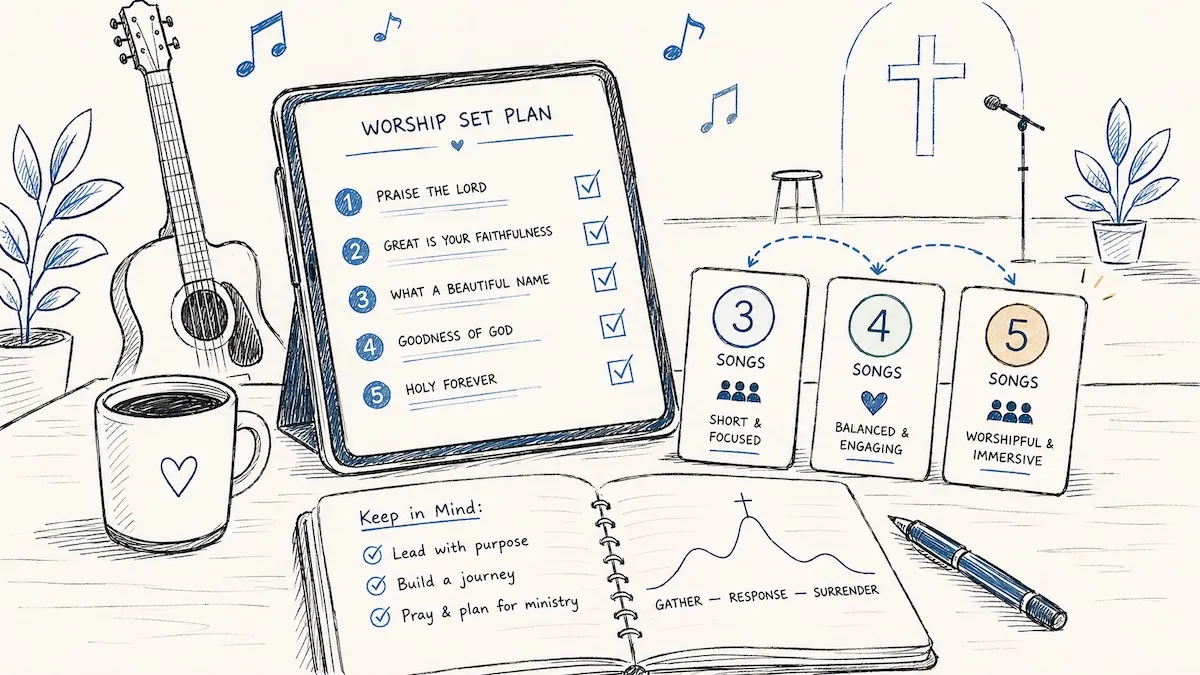
Most Sunday worship sets land between 4 and 6 songs in the main worship section — plus an opener and 1-2 closing songs. But the honest answer is: it depends on your service format, your church's style, the season you're in, and what the Holy Spirit is doing in the room.
This guide is for volunteer worship leaders who want a practical framework — not a one-size-fits-all rule — for planning the right number of songs for your church.
The Short Answer (For When You're In a Hurry)
For a typical Sunday morning service:
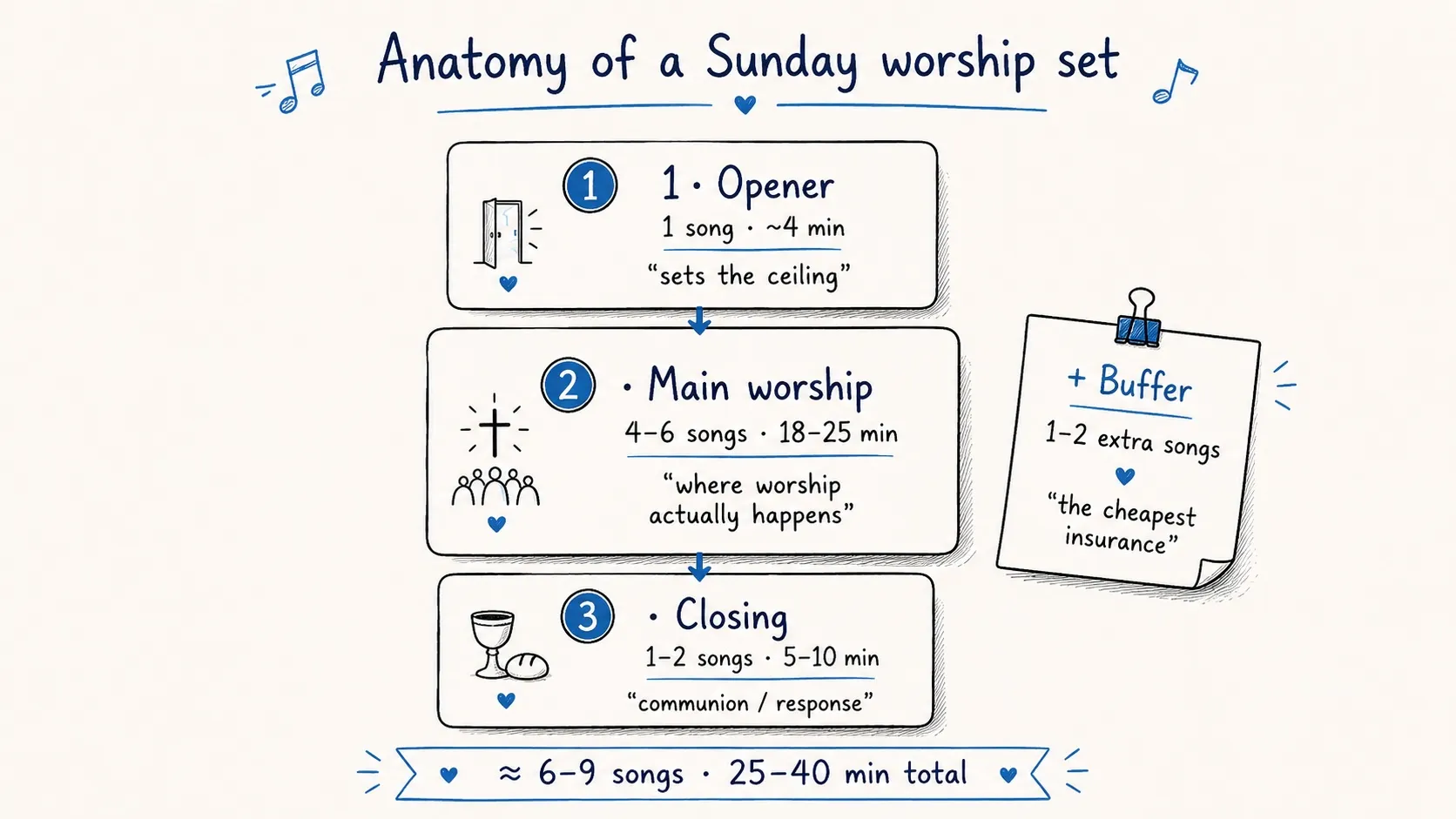
- 1 opening song — sets the tone before announcements
- 4-6 songs in the main worship section — the actual worship time before the sermon
- 1-2 closing songs — for communion, reflection, or a final praise moment
That's roughly 6-9 songs total for a standard Sunday. But the right number for your Sunday depends on how much time you have and what kind of worship the service is calling for.
If you need to know one thing: plan 1-2 more songs than you think you'll need. Always.
A Sunday That Taught Me Both Mistakes
I've gotten the number wrong in both directions, and they're painful in very different ways.
When I've planned too many songs and our pastor had to cut into the worship to keep things on time, I walked off stage feeling like I'd wasted all that preparation — there were moments I'd planned, transitions I'd rehearsed, a song I really wanted to do that never happened. That stings.
But planning too few is worse. There's nothing quite like standing on stage realizing the service has another twelve minutes of worship in it, your team is looking at you, the congregation is waiting, and you're trying to come up with a song everyone on stage actually knows. You're winging chord charts, calling keys from memory, hoping the drummer remembers how the song starts.
Both happen. They happen less the more you lead. But the lesson from both is the same: a small buffer of extra songs is the cheapest insurance you can carry.
What Actually Shapes the Number
Every honest answer to "how many songs" depends on these variables. Get a sense of them for your church and the number falls out naturally.
How much time you actually have
This is the first question, and most new worship leaders skip it. Ask your pastor or service leader directly: how much time does the worship section get this Sunday?
Sometimes they'll just tell you the meeting structure when you talk through the service. Sometimes you have to ask. And if you've never had that conversation, you can usually figure it out by experience — you've been there long enough to know roughly how long the music goes before the next part of the service starts.
Once you know your window, do the math. A typical sung song runs 3-5 minutes. So a 20-minute worship section is roughly 4-5 songs. A 25-minute section is 5-6. If the songs go longer — if they become prayer, if you let the room linger — one song can stretch much further, and you'll need fewer.
If you want certainty, play through your set at home with a timer. You'll know in 25 minutes whether your set fits.
The style of the meeting
A Sunday morning service is not a prayer night. A youth night is not Christmas Eve. The same number of songs serves these moments very differently.
- Prayer-focused services — songs often become prayer. A single song can carry 10-15 minutes. You'll usually need fewer songs but more space.
- Praise and celebration services — songs are sung, not stretched. Plan more of them.
- Youth services — usually higher energy. Songs people can move to. Often more songs.
- Older or traditional congregations — fewer songs, often more familiar ones, sometimes a hymn built in.
Ask your leader if they have style preferences too. Some want a hymn every week, some want long meditative worship sections, some want short and tight. That changes both the count and the song choice.
Special events and the season
Baptisms, baby dedications, communion-heavy services, anniversaries, Christmas, Easter — these reshape the available time. A Sunday with a baptism has less room for worship than a normal Sunday. Christmas Eve usually runs shorter. Your annual church celebration probably runs longer.
The song selection often changes too — more hymns at Christmas, more family songs on Sundays with kids ceremonies. The count isn't the only thing that flexes.
What the Holy Spirit is doing
This one doesn't show up in a planning spreadsheet. Sometimes a song you wrote down as "play once and move on" becomes the moment of the service and you stay there for ten minutes. Sometimes a song you were sure would land just doesn't, and you move on after one verse and a chorus.
Plan for the structured number. Hold it loosely. Watch the room. Ask before you walk on stage.
What Each Slot Is Actually Doing
Knowing how many songs you need is easier when you know what each slot is for.
The opener
The opening song does more than you think. At our church it's literally one song before announcements — short, welcoming, "we're starting now." But even that one song sets the spiritual ceiling for everything that follows.
It's almost always easier to bring people down from high than to bring them up from low. If you open with a banger and get the room engaged and standing, you can move into something deep and slow later — people are already in. If you open low and contemplative, getting the room back up later is much harder. Once people sit, they tend to stay sat.
That doesn't mean every opener should be a banger. A prayer night might rightly start deep — that sets a different expectation, and people know they're going there. But know what your opener is doing, because it's doing more than playing a song.
The main worship section
This is where the actual worship happens. For me, at least three songs in a row is the minimum to move past "singing songs" into something deeper. Some churches do one song between every other element of the service, and that works for them — but it's a very different feel. With three or more songs flowing together, the room has a chance to settle, to forget the next thing on the program, to actually worship.
This is where the 4-6 song range usually lives. The middle songs carry the weight.
The closing songs
After the sermon, the closing songs usually accompany communion, reflection, or a response time. These are typically slower, sometimes instrumental — the goal is space, not energy.
Occasionally a preacher hypes the room up at the end and wants to launch into a praise moment. Both can work, but watch the room. If the service has had a long prayer or reflection time and people have already started leaving, a closing banger won't land — the room is too thin. Match the closer to what's actually in front of you.
Introducing a New Song Without Breaking the Count
A common worry: "If I'm introducing a new song, do I need to do fewer songs?"
Not usually. A few practical moves:
- Play it during sound check so the early arrivers hear it before the service starts
- Play through it an extra time during the song itself so it sticks
- Briefly explain it if there's something the congregation needs to know to enter in
- Add it again at the end of the service if it fits the moment — they'll sing it twice in one morning, which speeds up familiarity dramatically
A congregation that's used to learning new songs handles them with less disruption than you'd expect. If yours isn't used to it yet, start there — make new songs a normal, predictable rhythm.
A Simple Workflow for Picking Your Number
- Ask your leader how much time the worship sections will get this Sunday — opener, main, closer.
- Estimate sung-song length at 3-5 minutes. Adjust longer if songs become prayer.
- Plan 1-2 more songs than the math suggests. Buffer is cheap.
- Play your set at home with a timer if you're not sure it fits.
- Pick your opener intentionally — it sets the ceiling.
- Choose closers that match the post-sermon flow — usually slower or instrumental.
- Stay flexible. Watch the room. Listen for what the Spirit is doing.
That's it. The number falls out of the variables — you don't have to invent it.
Key Takeaways
| Point | Details |
|---|---|
| Plan a buffer | Carry 1-2 more songs than the math suggests — cutting is easier than scrambling for one mid-service. |
| Time drives the count | Ask your leader the worship window first, then divide by 3-5 minutes per song. |
| The opener sets the ceiling | It's easier to bring a room down than up, so open at or above where you want to land. |
| Three songs is the floor | It usually takes at least three flowing songs to move a room from singing into worship. |
| Hold the number loosely | Plan the structured count, then watch the room and follow what the Spirit is doing. |
Where SONG7 Fits
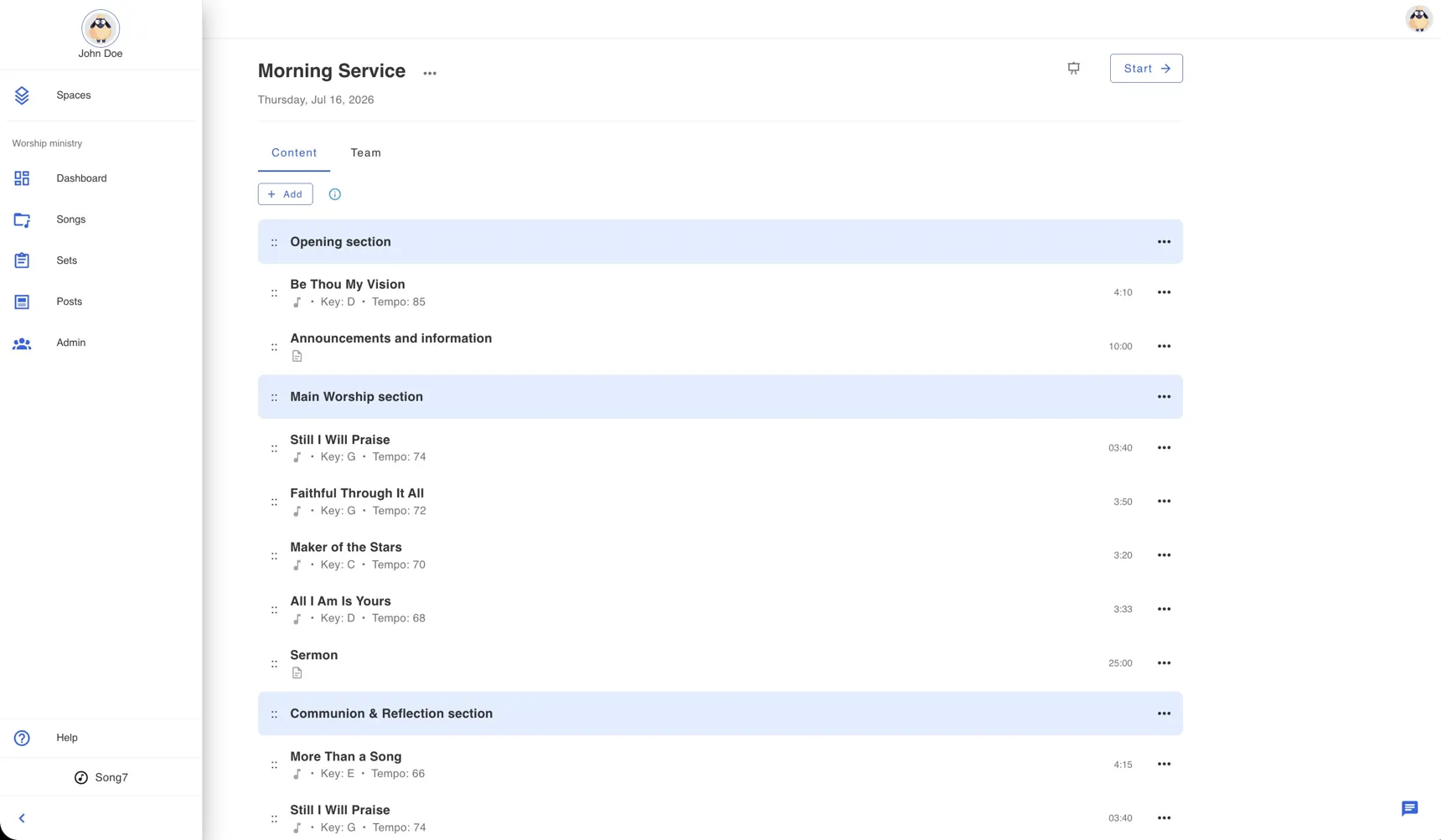
The buffer-song problem is exactly the kind of friction SONG7 was built for. When you plan 1-2 extra songs, you don't want to print extra chord charts or text new keys to the band the morning of. One click adds an extra song to your set and every musician on the team has it on their device, in the right key, with the right arrangement. That removes the last reason not to carry a buffer. See how Song7 builds and shares your set in one click.
Frequently Asked Questions
The One Thing to Walk Away With
If you're stressed about whether you've planned the right number of songs for Sunday, here's the whole answer:
Ask how much time you have. Estimate the runtime. Plan one or two more songs than the math says. Play through it at home if you're not sure.
That's it. There's no perfect formula because there's no perfect service. The number is just a function of the variables, and you can learn the variables.
And as worshippers, we always need more songs anyway.
Related reading: How to organize your church song library