Are We Singing the Same Worship Songs Too Often?
Probably not. If the congregation still sings a song, you haven't sung it too often. That's what the song is for. The band almost always gets tired of a song before anyone else does, so the team's boredom is a poor guide. There's no fixed number of weeks between repeats. Watch the room over several Sundays, notice when you no longer want to sing the song yourself, and when it's time, give it a rest for a season. Good songs come back.
This is written for volunteer worship leaders at small churches who plan most Sundays and quietly worry they keep picking the same songs.
How Often Should You Repeat a Worship Song?
We can't give you a number, and we'd be suspicious of anyone who does. At our church we've never counted. Each song has its own life, but over the years most of them have followed one of three patterns:
- Sung constantly for a season, then dropped. For a few months a song is on almost every set. Then it stops, and it doesn't come back.
- Back in waves. A song is sung for a while, rests, and returns later. A break is good for a good song. It comes back fresh.
- Evergreens. Happy Day, 10,000 Reasons and I Could Sing of Your Love Forever are long past being new, and we still sing them at least once a month. People sing them loudly every time.
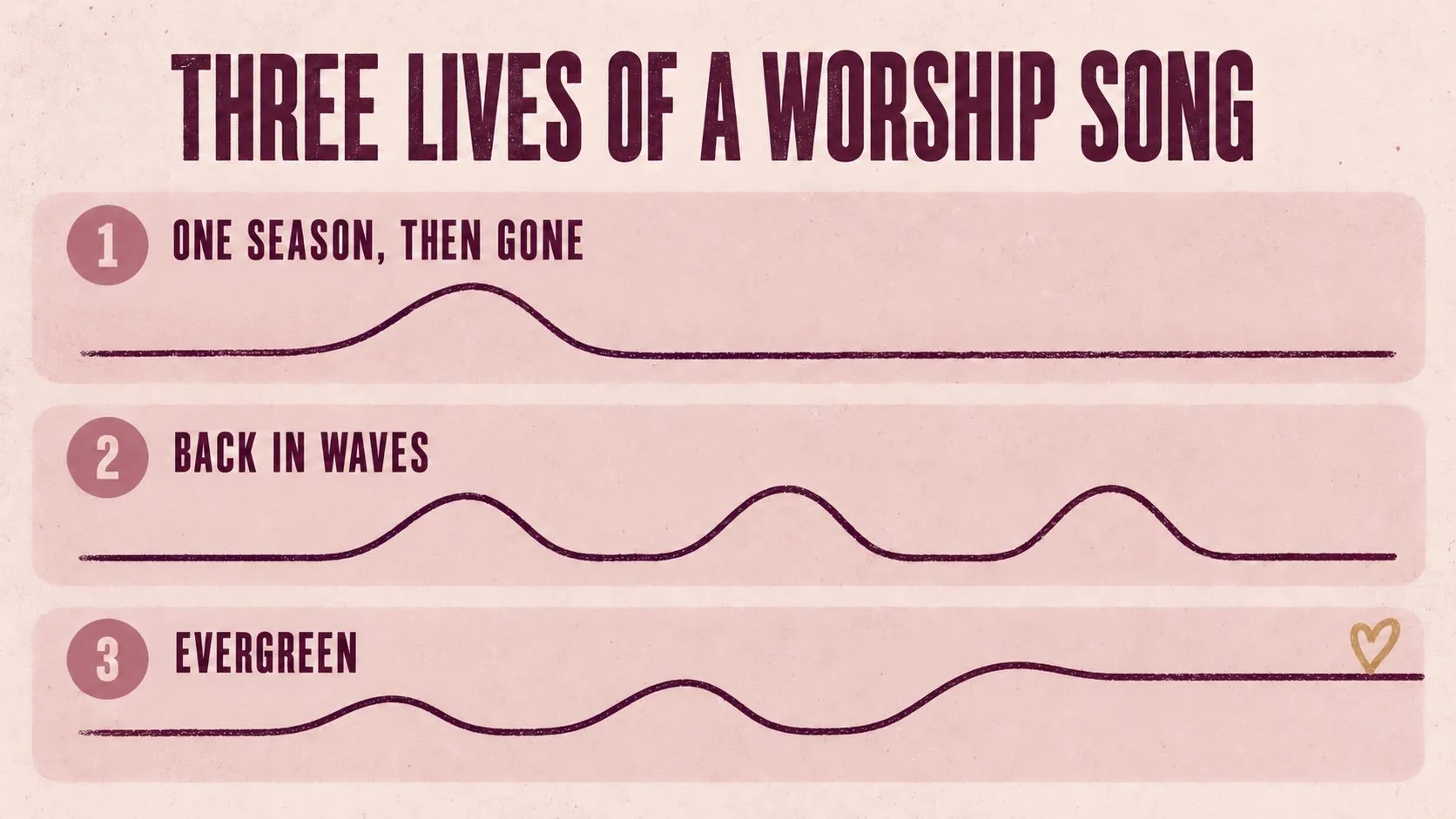
None of these is a mistake. The first is how most worship songs live: they serve a church for a season and then step aside. The point isn't to keep every song going forever. It's to notice which of the three you're dealing with.
Scripture holds both sides, too. Psalm 96 opens with "Sing to the Lord a new song", and Psalm 136 repeats the same line, "His love endures forever," in every one of its 26 verses. Repetition in worship isn't a failure of imagination. Sometimes it's the point.
Why Does the Band Get Tired of a Song Before the Congregation?
Because the band hears it many more times. A congregation meets a song on Sunday morning. The band has already learned it at home, run it at rehearsal, played it at soundcheck, and then plays it again in the service. By the time the congregation has sung a song five times, the guitarist may have played it thirty.
So it's normal for a team to be tired of a song while the room still loves it, and it's normal to keep playing it long after the team would have moved on. That's part of being a church musician. Small changes can help the band stay awake inside a familiar song:
- Rework the transitions in and out of it so they're less predictable.
- Strip it back to an acoustic version for a week.
- Give the lead to a different singer, for example a female voice instead of a male one.
- Change who plays the intro, or leave one instrument out of the first verse.
None of these fixes boredom completely. They buy a song a few more months. When a song has truly run its course for the team and the room, the usual answer is simpler: take it off the list for a while.
How Can You Tell When a Song Is Worn Out?
There are signs, not rules. The extremes are easy to read. If everyone sits down, stops singing or leaves the room, that's a clear message. If the whole room stands, sings out, lifts their hands or ends up on their knees, the song isn't worn out, whatever the band thinks.
Most Sundays are somewhere in between, and harder to read than the extremes. Some people sing while others sit. Some are deep in worship while the person next to them is miles away. Very often that has nothing to do with the song:
- People's own week with God. Someone in a good season tends to engage. Someone in a desperate season may sing hardest of all, because they're seeking God.
- The atmosphere of the morning. Rain, sunshine, a tense notice at the start of the service, a room half full because of a school holiday. All of these change how a song feels.
- Where the song sits in the set. A song that soared last month can feel out of place this week, simply because of what came before it.
So one quiet Sunday tells you almost nothing. If people didn't engage much this week, that doesn't mean they won't next week. What you're reading is the general temperature of the room over several Sundays, not a single moment.
It's also worth holding your own reading loosely. People sometimes come up afterwards to say a song spoke straight into their situation, and it's often one the band thought went badly. You can't see what God is doing in every person in the room. If you sense God asking you to lead a particular song, it may be that most of the room doesn't respond and one person needed exactly that.
Your Own Boredom Still Counts
The band's boredom is a poor guide to what the congregation thinks. But there's one kind of boredom you should take seriously: the worship leader's.
If you don't want to sing a song, it shows. People can feel it when the person leading them isn't really in it. Don't expect a room to engage with something you aren't engaging with yourself. And if you're bored with a song, there's a decent chance some of the congregation is too.
That's why, at our church, it's mostly the worship leader who retires songs. There's no survey and no feedback form. When a leader feels it's time for something else, the song stops appearing on their setlists. It's an intuitive call, made in prayer, and in our experience that's how it should be.
Why Do Some Songs Never Wear Out?
We honestly don't know. Plenty of popular songs we sang for years are gone now, while Shout to the Lord, Here I Am to Worship and Blessed Be Your Name still come back. They're mostly older songs with a chorus anyone can pick up, but so were plenty of songs that faded.
Two things we have noticed, though, both about songs that belong to the church:
Songs in your own language get more grace. Our congregation prefers singing in our own language, even though many of the strongest songs come from English. Native songs are forgiven more, and often stay longer. Sometimes the best English songs get translated, which gives them the same advantage. If your church sings in a language other than English, you've probably seen the same thing.
The younger people in our church seem to lean the other way, toward English songs. It's hard to measure, but our impression is that it isn't really about the language. Young people tend to want what's new and fresh, and more new songs come from English.
Songs written inside the church stay for a very long time. Songs our own people wrote come up again and again, even when they aren't the strongest songs in the library. The church has a relationship with them that a song from the radio doesn't have.
So part of what makes a song last seems to be ownership, not just quality. That's worth remembering before you retire a song your church wrote. It may be doing something for the congregation that a better-written song can't.
Keeping a Season's Songs Within Reach
For years our song library just grew and grew. Every new song was added, nothing was taken out, and finding the songs we actually sang meant scrolling past hundreds we didn't.
Now each season's rotation lives in its own Collection in Song7: a named group of songs that the whole team can see, separate from the full library. Last season it held about 50 songs. That's still plenty to choose from, and two leaders can pick completely different sets from it. But it's much easier for the team to practice 50 songs than a whole library, and much easier to find what's currently in use. The leaders can agree in advance on what the church will be singing this season, and still reach outside it when a Sunday needs something else.
It doesn't decide anything for you. It just keeps the season's songs together, so retiring one is a matter of taking it out of the Collection rather than trying to remember not to pick it. We wrote more about separating your active rotation from the rest of your library in an earlier post.
Key Takeaways
| Point | Details |
|---|---|
| If people sing it, it isn't overplayed | Helping people sing and worship is what the song is for. |
| The band tires first | The team plays a song many more times than the congregation hears it. That's expected. |
| Read several Sundays, not one | Weather, people's week with God and the order of the set all change how a song lands. |
| Take your own boredom seriously | If you don't want to sing it, the room can feel it. |
| Retire songs for a season, not forever | Good songs come back in waves, and often sound better after a break. |
| Songs that belong to the church last | Songs in your own language and songs your people wrote tend to stay much longer. |
Frequently Asked Questions
Before the Next Season Starts
If you're worried you keep picking the same songs, don't be. As long as people are singing with you, it isn't a problem.
If it has started to feel strange to you, or the room has gone quiet over several weeks, set some time aside before the next season. Ask God what to sing. Listen through songs you haven't used in a while, and a few new ones you'd love to lead. Pick the ones to add, then give the team time to learn them. One new song per rehearsal is plenty. And when a new song arrives on a Sunday, singing it twice in one morning helps it settle in fast.
The old songs will still be there when it's their turn again.