How to Lead Worship Alone or Without a Full Band
A thin lineup is not a problem to be survived — it's a different mode of worship, and often a better one for the room you're actually in. Play the songs you can carry on your own, turn the intimacy up and the performance down, and let whoever else shows up add to that rather than prop it up.
Written for volunteer worship leaders at small churches, where the drummer is on holiday, two people are ill, and Sunday is still coming.
Start From What You Can Play Alone
The most useful habit a worship leader can build is knowing what you can lead entirely on your own — just you and a guitar, or you and a piano.
That becomes your floor. If you can lead worship alone and genuinely engage people with one instrument, then everyone who turns up adds to that. The drummer adds power. A second voice adds warmth. Keys add width. None of them are holding the thing up, because you already were.
Build it the other way round — arrangements that only work when all seven people are present — and every absence is a small crisis. Same team, same songs, completely different Saturday night.
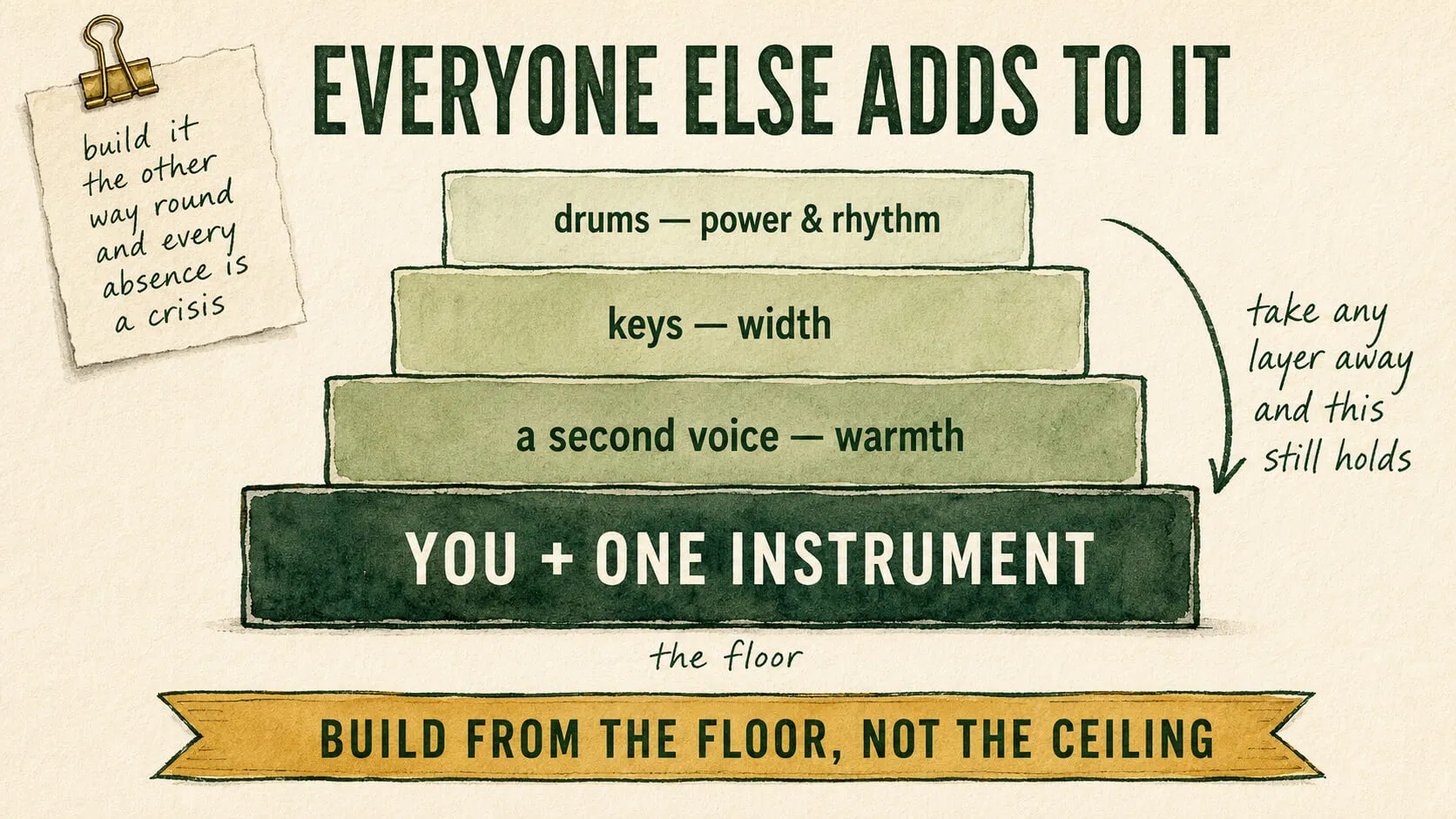
This also quietly answers the question of what to do when someone drops out on the morning. If the floor is solid, you're not rebuilding the set. You're just playing it with less on top.
Dial Up the Intimacy, Dial Down the Performance
Stripping a set back doesn't remove something — it trades one thing for another. You lose power and width. You gain closeness, and closeness is not a consolation prize.
Watch how touring artists handle this. Most full-production shows have a moment where everything drops away and it's one person and one instrument, and the room leans in rather than checking out. That section is deliberate. Nobody thinks the band broke.
The mistake is trying to run a full-band arrangement with three people, so it sounds like a big song played badly. The move is to change what you're aiming for: fewer dynamics stacked on top of each other, more space, more voice, more room for the congregation to be the loudest thing in the building.
Practically, that means letting songs breathe, allowing actual silence, and resisting the urge to fill every bar because the drums aren't there to fill it for you.
Which Songs Survive Being Stripped Back
Pick songs you already know work with just you playing them. Not songs you think should work — songs you have actually played alone and found something in.
A useful indicator: if you can worship to it at home on your own, it will probably work in a gathering. If it doesn't work at home, it very likely won't work anywhere else.
Treat that as a strong signal, not a law, because it leaks in several places:
- A gathering isn't your living room. At home you can be unaware of your surroundings and sing whatever you like. Leading means being aware of people in a way that changes what fits.
- A team lets you do more than you can alone. Plenty of songs that don't survive solo are excellent with four people. Failing the test doesn't retire a song; it just means not this Sunday.
- Nerves are real. Some people play something perfectly at home and can't do it in front of a room. That's not a song problem.
Music has too many variables for a clean rule. But when you're the only one playing, you have to be able to play it alone — so "can I actually carry this by myself?" is at minimum a very good filter.
Beyond that, the usual guidance holds: favor familiar, singable, lyric-driven songs, and be suspicious of anything that only makes sense with the studio production underneath it. It's also worth checking the key — with no band to carry energy, dropping a song a step so it sits in a comfortable talking range does more for congregational singing than volume ever did.
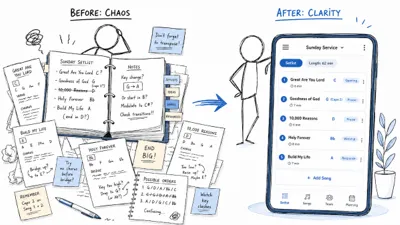
Being able to pull up any song in your library, in whatever key you need, on your own device is what makes a last-minute solo Sunday workable rather than frantic — that, and having the library organized in the first place. See how Song7 keeps your songs and keys to hand.
What the Missing Drummer Actually Takes Away
Losing the drummer changes the sound more than losing anyone else. Rhythm and power both come down significantly, and the faster, more driving songs are hit hardest — those are the ones leaning most on what the kit was providing.
The absence you genuinely can't work around is a main harmonic instrument. Guitar or piano is what carries chords and melody together; without one of those you're in real difficulty. Drums and bass alone won't hold a congregational song up, however good the players are.
Some practical compensation when the kit is empty:
- Let the rhythm instrument do two jobs. A guitarist can mark where the snare would land with muted strokes and lean on the low strings for root notes, covering a little of both bass and drums.
- Use dynamics instead of volume. Fingerpicking, palm muting and simply not playing for a section will shape a song more than strumming harder. As Worship Ministry Training puts it, strategic silence and layering are what build dynamics on a small team.
- Separate your frequencies. If a piano is filling the low-mids, a capo moves the guitar up into brighter voicings so the two aren't fighting for the same space.
- Ask the sound tech for help. Removing the high-pass filter on an acoustic guitar preserves low-end thickness when that guitar is carrying the whole song.
- Consider a pad. A soft tonic pad under a chorus adds width without adding a person.
Is Half a Band Harder Than No Band?
Half a band is musically easier and organizationally harder, and it's worth knowing which of those is actually biting you on a given week.
Being completely alone has a hidden advantage: there is nobody to coordinate with. No arrangement to agree, no key to communicate, no one to wait for, no chance of two people expecting different things at the same bar. You prepare, you show up, you play.
Every additional person adds musical support and the cost of sharing and coordinating. That's a good trade almost every time — but it means a three-person lineup thrown together on Saturday can genuinely feel more stressful than playing solo, even though it will sound fuller. If that's your week, spend your energy on agreeing the arrangement clearly rather than on making it more ambitious. Our guide to structuring a rehearsal covers most of this.
Keeping the Room Singing When It's Just You
Congregational engagement isn't really a solo problem — a full band can lose a room just as easily. It comes down to whether you're performing at people or inviting them in, and whether they know the songs.
The thing worth remembering: people came to worship, not to watch you or listen to you. So the job is helping them do that, reminding them why they're there, and then getting out of the way.
A short invitation is usually enough. Let's stand and worship together. Let's lift our hearts. Let's give Him thanks. Something that fits the song and the moment. You don't need much talking between songs, and more talking is rarely the fix.
One caution, because most advice on this quietly assumes you're an extrovert: don't try to hype a room in a way that isn't you. If you're naturally quiet, manufactured enthusiasm reads as inauthentic, and the room feels it immediately. It can have precisely the opposite effect to the one you wanted. Lead the way you actually are, and put the preparation into your own heart before the service rather than into a performance of energy you don't feel. Our reflections on preparing to lead go further into that than a practical guide can.
When You Genuinely Can't Carry It Alone
If playing and singing at the same time isn't something you can do yet, the honest answer is different: you'll be leaning on recorded material, and that's a legitimate way to serve a congregation.
The options have quietly got very good:
- A loop pedal. Record a rhythm part live and play over it. Whole solo concerts are built this way, and it can restore some of the drive that faster songs lose without a band.
- Pads and backing tracks. A sustained pad under a song, or a full backing track where it fits the setting.
- Stems. Modern audio tools can separate almost any recording into its parts — drums, bass, keys, vocals — so you can play back only the pieces you're missing and leave room for what you are playing live.
Two cautions. Anything you play back has to be rehearsed like a band member, because it will not follow you — if the Spirit takes a chorus somewhere else, a track carries straight on. And a room can tell the difference between a track supporting live worship and a track replacing it. Use it to fill gaps, not to manufacture an atmosphere.
There's an older precedent for all of this, of course. One man with a lyre was enough to change the atmosphere in a room, and nobody has improved on the arrangement much since.
Key Takeaways
| Point | Details |
|---|---|
| Build from the floor up | Know what you can lead with one instrument; everyone who shows up adds to that instead of holding it up. |
| Intimacy replaces power | Stripped back isn't a lesser set — trade width and drive for closeness, space and congregational voice. |
| Play what you've played alone | If you can worship to it at home by yourself it will likely work; treat that as a strong signal, not a rule. |
| The drummer changes the most | Rhythm and power drop sharply without a kit, and fast songs suffer first; a harmonic instrument is the one you can't lose. |
| Half a band costs coordination | Extra players add musical support and the overhead of agreeing arrangements — solo has no coordination cost at all. |
| Lead as yourself | Manufactured energy reads as inauthentic; invite people in, then get out of the way. |
Frequently Asked Questions
The Sunday Nobody Else Could Make
There will be a Sunday — a holiday week, a bug going round — where it's just you. It is genuinely fine. Play the songs you know in your bones, keep the keys where people can sing, say a short honest sentence to invite the room in, and then lead the way you actually are.
If it helps: nobody writing this is a perfect worship leader. Some of us have simply done it faithfully for a lot of years, in small rooms, often with less than we wanted. That turns out to be enough more often than not.
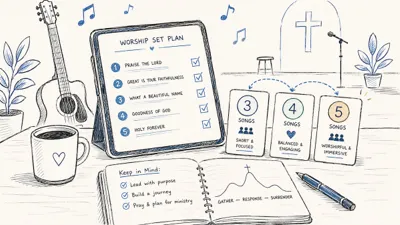
Related reading: how many songs to plan for a set.