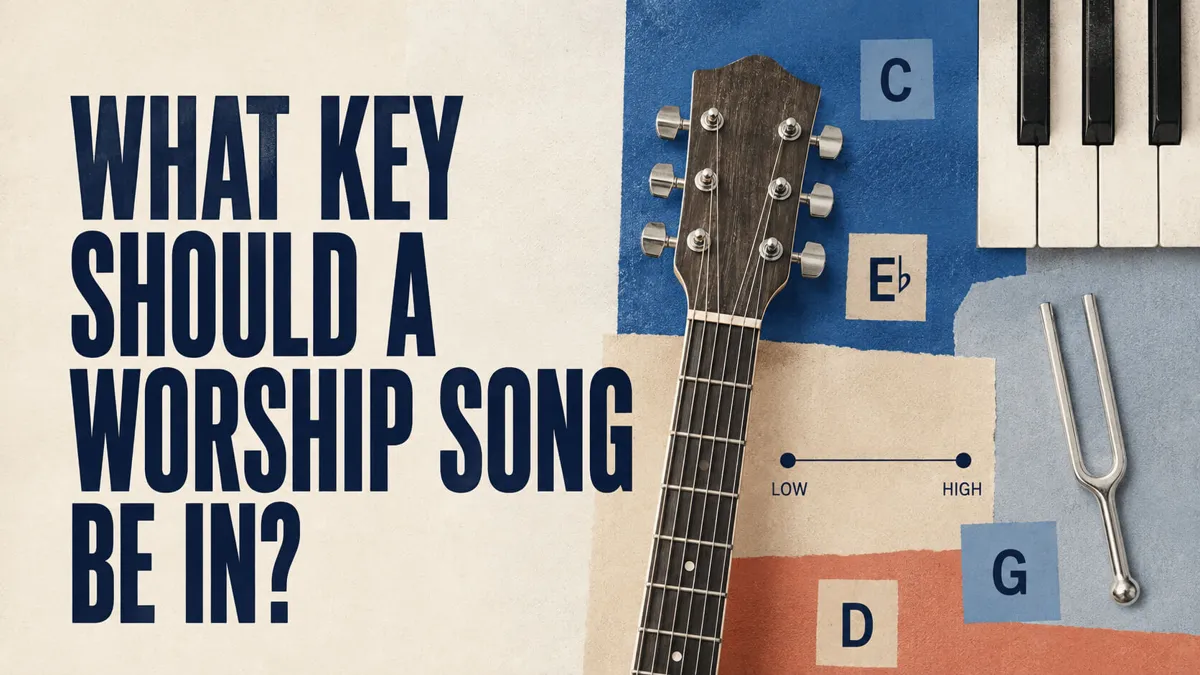
What Key Should a Worship Song Be In?
The right key for a worship song is the one that puts the melody's highest note at C5 or below and its lowest note no further down than A3 — an octave and a fourth that most untrained voices can reach without thinking about it. Start from the range of whoever is carrying the song, then move it a step or two so the room can follow.
This guide is for volunteer worship leaders who have never been taught the mechanics and have been picking keys on gut feel. Gut feel gets you surprisingly far. A few numbers get you the rest of the way.
The Short Answer (For When You're In a Hurry)
- Ignore the original key. It was chosen for the artist's voice, not your leader's and not your congregation's.
- Find the melody's highest and lowest note — not the key. Two songs in G can sit an octave apart.
- Aim to land the top note at C5 or lower. D5 is fine for one short peak. Above that, the room goes quiet.
- Keep the bottom note around A3. Much lower and people mumble instead of sing.
- Fit the key to whoever leads, then move it a step if the rest of the team or the room can't follow.
- Land on a key your band can actually play — E, G, A, C and D cover most of it.
And the test that saves you every time: if anyone is thinking about whether the song is too high or too low, it's the wrong key. The right key is the one nobody notices.
The Voice You Have on Sunday Morning Isn't the Voice You Had at Rehearsal
Most wrong keys get caught in rehearsal. The ones that don't get caught have a pattern: they were fine on Wednesday evening.
By mid-week rehearsal your voice has been awake for twelve hours and used all day. Sunday at 10am it hasn't, and if the morning ran late there was no time to warm up at all. The note that sat perfectly on Wednesday comes out thin and squeaky in the chorus, or the bridge lands somewhere you can't take it. Nothing about the song changed. The voice did.
The lesson is a margin, not a rule: if the top note is only reachable with a warm voice, it's already too high. Set the key so the peak is comfortable cold, and the warm version will sound even better.
The congregation is in the same situation, only more so. They walked in from the car park. They haven't sung a note yet, most of them don't think of themselves as singers, and they're not going to work at it. If the melody climbs past what they can reach, they don't strain — they invent a lower alternate melody, or they stop singing and listen. Nobody should have to make up their own tune to join in.
What Range Can a Congregation Actually Sing?
Most congregations sing comfortably between A3 and D5 — roughly an octave and a fourth. Bob Kauflin puts the working boundary at "a low A to a high D" and notes that the strongest range for a congregation sits between G and D. Worship musician Greg Scheer's often-cited version is slightly tighter: B♭3 to D5.
The research is tighter still. Paul Ryan, who mentors student worship leaders at Calvin University, points out in Highs and Lows of Singing that a comfortable range for 84% of young adults is only G3 to B4 — an octave and a third — while about three-quarters of a congregation can stretch up to C5.
Two things follow from that:
- C5 is your practical ceiling for anything sustained or repeated. D5 is a peak note, not a home.
- A3 is your practical floor. Below it voices lose power and drift flat.
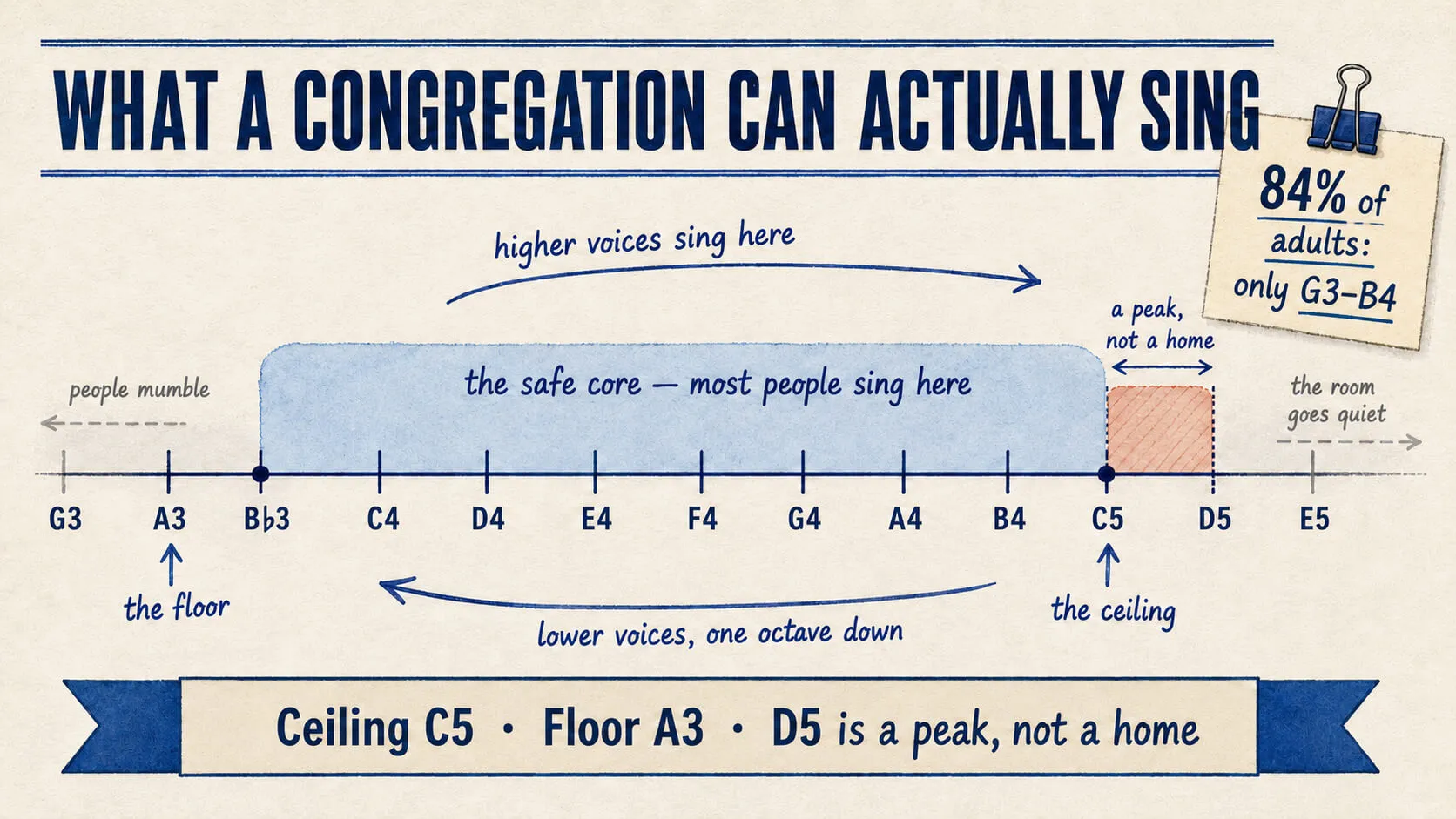
This is also why a mixed room works at all. Higher voices sing the melody at pitch; lower voices sing the same melody an octave down. One written range serves both — which is exactly why that written range has to be narrow enough for both.
Why the Key Doesn't Tell You the Range
A song's key tells you which chords the band plays. It says nothing about where the melody sits. Two songs both written in G can be an octave apart — one topping out at B4, the other reaching E5. Moving a song "to G" because G worked last time is guesswork.
The number you actually need is the melody's highest note. Find it once:
- Play the recording and pick out the peak line — usually the top of the chorus or the bridge.
- Hunt that note down on a piano or guitar.
- Write it on the chart. You never have to do it again.
Once you know the top note, choosing a key stops being a feeling and becomes arithmetic:
| If the melody's top note is | What to do |
|---|---|
| E5 or higher | Move down 3-4 semitones. This song is written for a soloist. |
| D5 | Move down 1-2 semitones, or leave it if it's one brief peak. |
| C5 | Leave it. This is the sweet spot. |
| B4 or lower | Consider moving up a step if the song feels flat and low on energy. |
How Do I Find the Right Key for a Song?
Work through it in this order — the whole thing takes about five minutes the first time you do a song, and zero minutes every time after.
- Start with whoever is carrying the song. The lead voice has to be able to sing it well, every verse, cold. If they can't, nothing else matters.
- Check the top note against the C5 ceiling. If it clears, you're probably done.
- Check the bottom note against the A3 floor. A key that fixes the chorus and buries the verse hasn't fixed anything.
- Adjust a step for the room, not two. A small move down usually buys you the congregation without costing the leader much.
- Round to a key the band can play. You can't move a song by a hair — you have to land somewhere playable.
- Write the key down where the whole team sees it, not on your own chart.
Step 5 is the one people forget. Keys are not a dial you turn smoothly; they're a set of stepping stones. Deciding "this needs to come down slightly" and landing on C♭ is not a decision your volunteers can play. You move to the nearest key that works for both the voice and the hands.
What If the Song Is Too High for the Women on Your Team?
Fit the key to whoever is carrying the song, then adjust for everyone else — and accept that some songs are going to be led by someone other than you.
This shows up most often with a song recorded by a male artist. It sits perfectly in a male leader's range, so it feels like a great fit. But the women singing with him aren't singing an octave down — they're singing it at pitch, which puts a comfortable G4 peak for him at G5 for them. That isn't a stretch, it's a different song.
In rough order of least disruption:
- Let the harmony singers move off the melody. Experienced singers do this instinctively — if they can't reach the line, they build a harmony under it. That often sounds better than the unison would have.
- Give the song to whoever it fits. If it's a female-led song, set the key to her range and let the men sing an octave down. Handing a song over is a normal, healthy thing for a team to do.
- Move the key — to the nearest playable one, not to a theoretical one.
- Let it go. If the song only works when one specific person is available, it will quietly stop getting picked anyway.
The judgement call is simpler than it sounds: a couple of notes out of reach is survivable. A whole chorus out of reach isn't. If someone is dreading one line, that's fine. If they're bracing for the entire chorus, move it.
Which Keys Should a Volunteer Band Play In?
E, G, A, C and D carry most worship music and are the friendliest for volunteers — plus B and F when someone has a capo. These keys use open chord shapes on guitar and stay clear of the sharps and flats that slow a new piano player down.
Keeping the defaults boring is a deliberate choice, not a lack of ambition. A team of 1-2 keys players, a drummer, 1-2 guitarists and 1-2 singers usually has a mix of experience levels in it, and the person who just learned three chords last month is the one who decides how many keys are actually available to you. The strong players will push for more interesting arrangements, and that's genuinely good — but the default key set should be the one the least experienced player can hit without rehearsing it twice.
A capo is worth owning. It lets a guitarist keep familiar shapes in an unfamiliar key, and with two guitars it gives you a high part and a low part playing the same chords in different voicings. The cost is time: fitting it mid-set and re-tuning afterwards interrupts the flow if it isn't something you do regularly. Recommended, not required.
When Lowering the Key Makes the Song Worse
Lowering a key can drain a song, and that instinct is worth trusting. Powerful lyrics often need a range where you can put some air behind the note. Drop a declaration song far enough and everyone can sing it — but nobody wants to, because there's nothing to push against. Too easy has its own failure mode.
There's a real distinction underneath this. Slow songs with a narrow range travel down well; they weren't running on pitch in the first place. Uptempo songs are the ones that suffer, because the energy in the room and the effort in the voice are connected.
Kauflin's answer to this is the most useful thing on the subject: the leader doesn't have to carry the melody the entire time. Add harmony and vocal fills in strategic places and let the volume come from the room. As he puts it, "I want the energy to come from the congregation, not me." A hundred people singing at a comfortable pitch is louder and more alive than one person straining above them.
The rest of the energy comes from the groove, the band's commitment and the arrangement — not from the pitch. But if a song genuinely dies a step lower, take that as information: it may be a song for the team to perform in a special moment rather than a song for the congregation to sing.
The Songs a Key Change Can't Rescue
Transposing moves the whole melody at once. It can't narrow the distance between the lowest note and the highest one — which means some songs have no right key at all.
You'll recognise them. The verse sits low and intimate, the chorus jumps to a peak, and the gap between them is wider than an octave and a fourth. Move it down and the verse turns into mumbling. Move it up and the chorus turns into shouting. There's no setting that fixes both, because the problem isn't where the melody sits — it's how far it travels.
The other common version: the recording jumps up an octave for the final chorus. The artist has the range for it. You may not. So you stay in the lower octave, the last chorus lands exactly where the second one did, and the song ends flat. Lower the key to make the top comfortable and the whole rest of the song drops into the basement.
If the melody spans much more than an octave and a fourth, no key will fit it. Those songs tend to fall off the rotation on their own, in favour of ones the team can sing and mean. That's not a failure — it's the same instinct that keeps your song library honest about what's actually in rotation. Not every great recording is a congregational song, and there is no shortage of songs.
Key Takeaways
| Point | Details |
|---|---|
| C5 is the ceiling, A3 is the floor | Land the melody's top note at C5 or below and its bottom around A3; D5 is a brief peak, not a home. |
| The key isn't the range | Two songs in the same key can sit an octave apart — find the melody's highest note, then transpose. |
| Fit the leader, then adjust | Set the key to whoever carries the song, then move it a step so the team and the room can follow. |
| Keep the keys playable | E, G, A, C and D serve volunteer bands; a capo buys you the rest without new chord shapes. |
| Some songs can't be fixed | Transposing moves a melody but can't narrow its range, so a huge verse-to-chorus leap has no right key. |
Where Song7 Fits
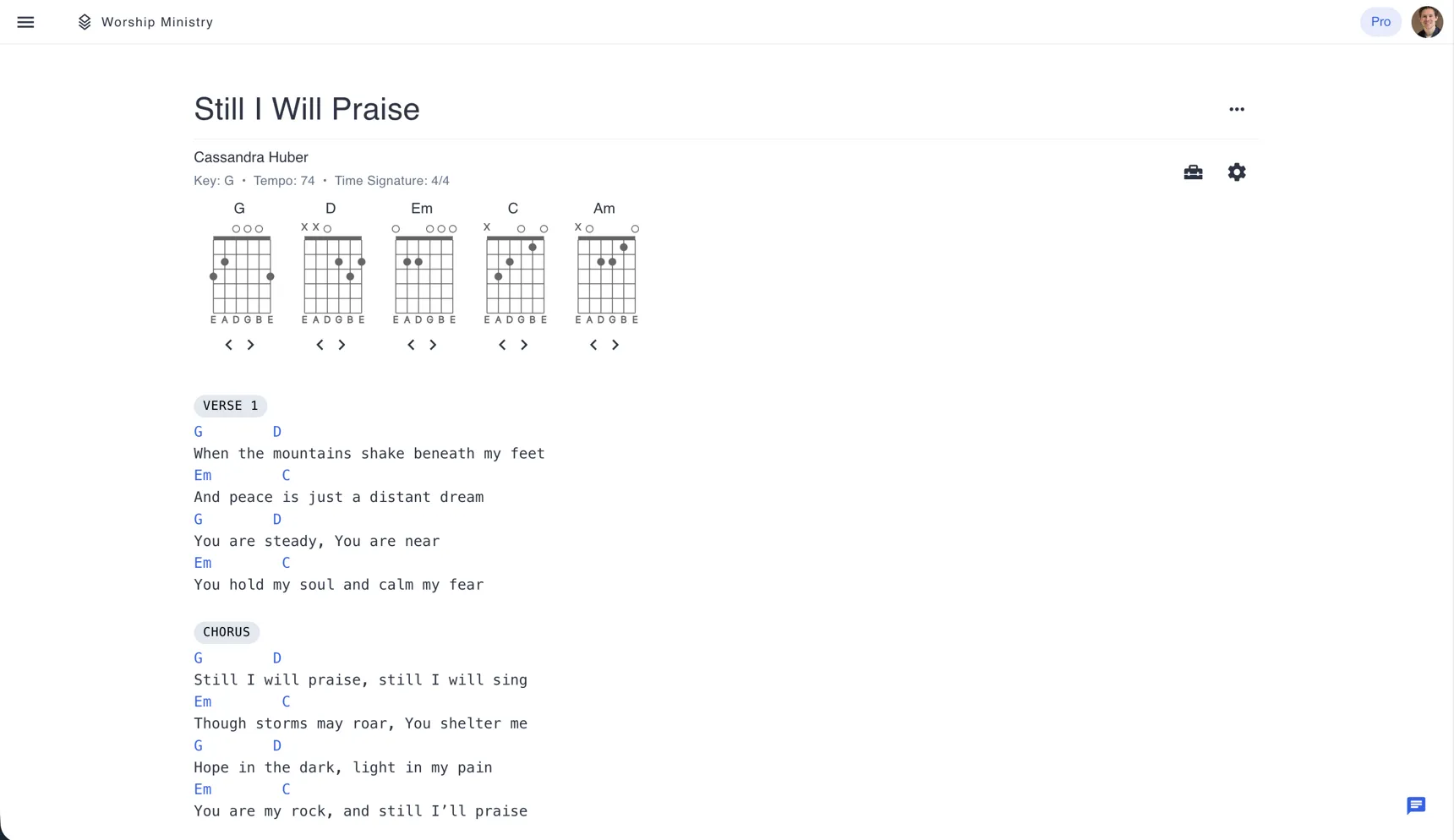
Deciding the key is the hard part. Getting that decision to seven people before Sunday shouldn't be. In Song7 the leader sets the key on the song — either as its default or just for that one set — and every musician sees the transposed chart on their own device immediately. No reprinting, no pen edits ten minutes before the service, nobody showing up playing last year's key. Individual players can still view the song in their own key or with a capo without changing what anyone else sees. See how Song7 keeps your team on the same key.
Frequently Asked Questions
The One Thing to Walk Away With
Take one moment, before the week gets loud, to actually consider the key. That's it. Most wrong keys aren't wrong because someone made a bad musical judgement — they're wrong because nobody stopped to ask the question, and the song stayed wherever it happened to land.
Ask it once per song. Find the top note, put it at C5 or under, keep the bottom off the floor, land somewhere your band can play, and write it down where the whole team can see it. Then let it go and lead.
Because the point was never a technically correct key. The point is singing to each other — a room full of people who can open their mouths and mean it without wondering whether they'll make it to the next note. Getting the key right is one of the quietest, most practical gifts you can give them.
Related reading: How many songs should be in a worship set?